November Employment Report: Good Enough

by Thomas Cooley and Peter Rupert

Establishment Survey

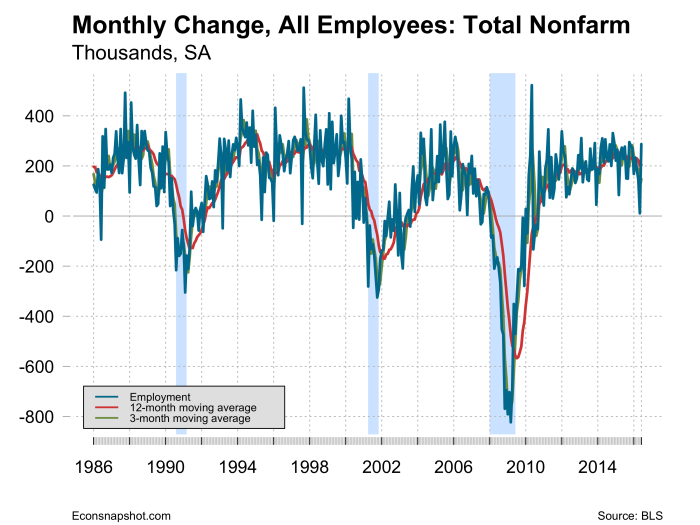
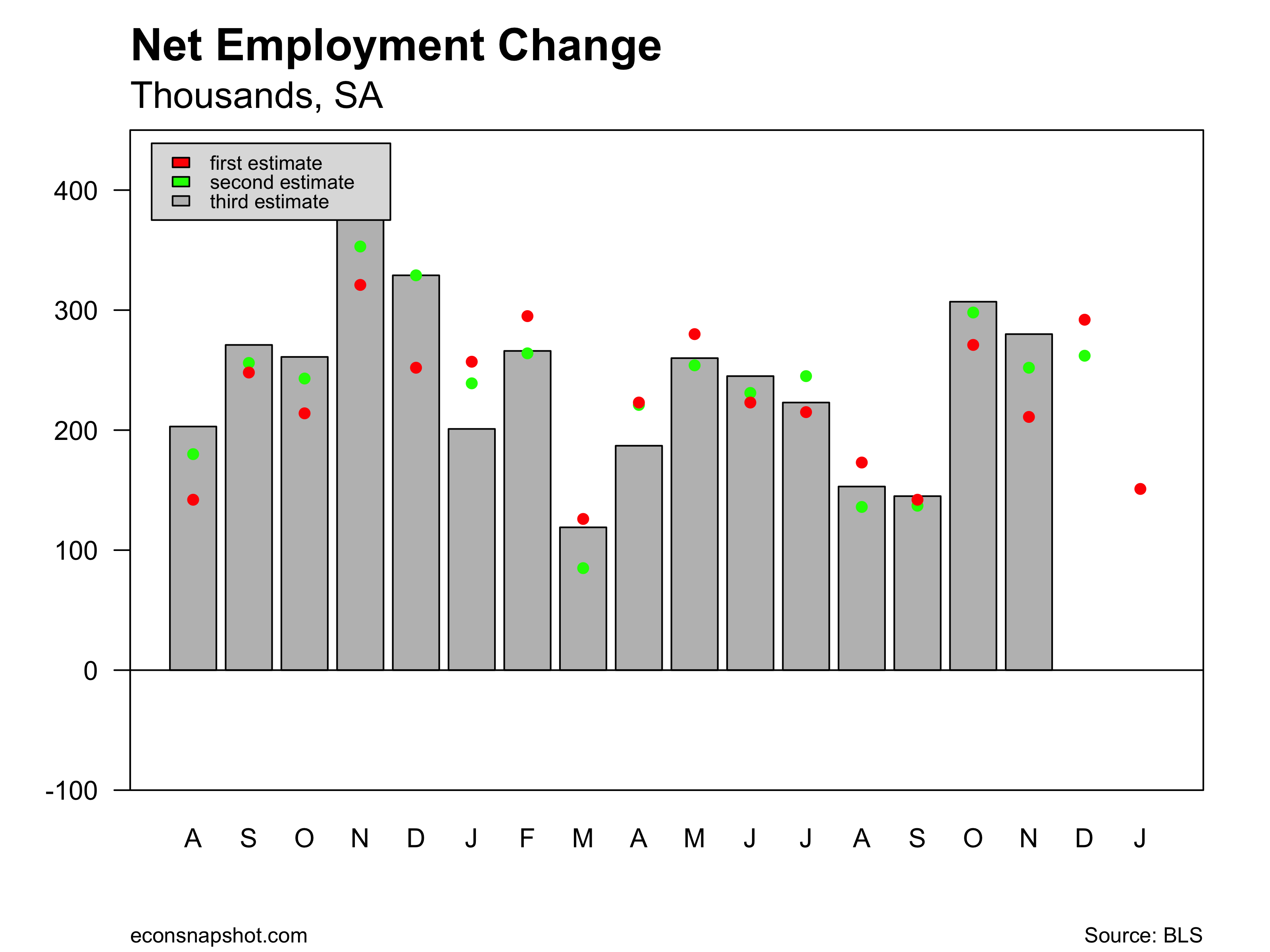
The Bureau of Labor Statistics establishment survey for November shows an employment increase of 211,000 jobs, with an upward revision of 27,000 jobs for October and down 5,000 jobs for September.

empchgm-2015-12-04

Average weekly hours fell slightly, from 34.6 to 34.5 and average hourly earning were essentially flat. Since 2009 the BLS also produces data for all private workers, evidently higher than for just production and non-supervisory workers; however, the same basic pattern emerges. The recent climb in real hourly earning stems almost entirely from the decline in inflation as nominal earnings growth has hovered around 2% for the last five years or so.
avghours-2015-12-04

ahetpps-2015-12-04

ahetpreal-2015-12-04

ahepscpiyoy-2015-12-04.png

Household Survey

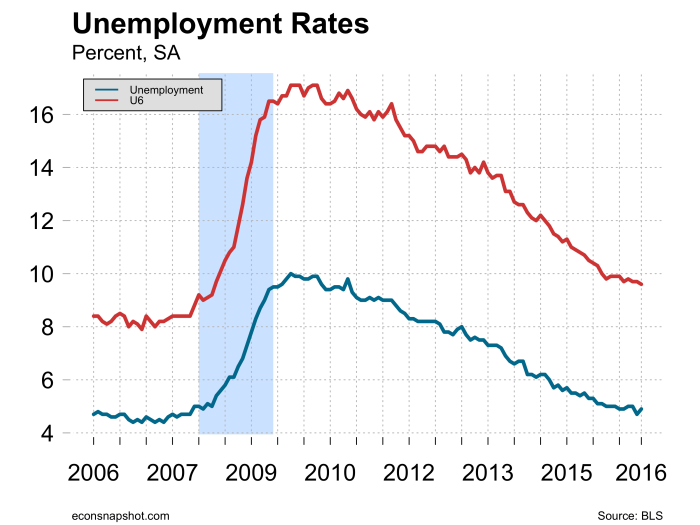
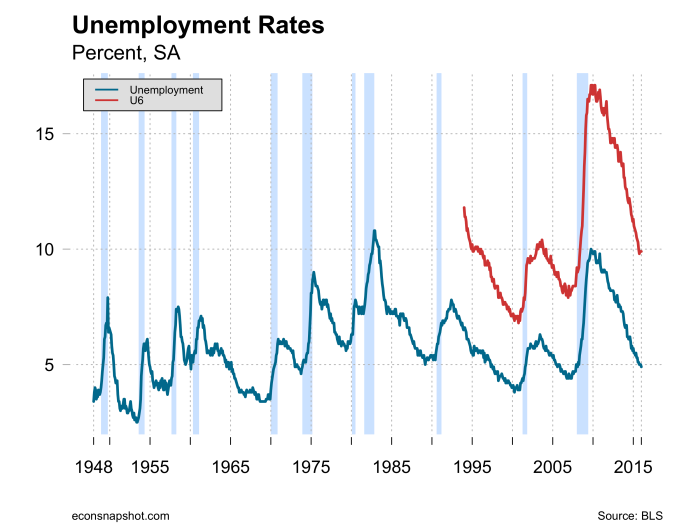
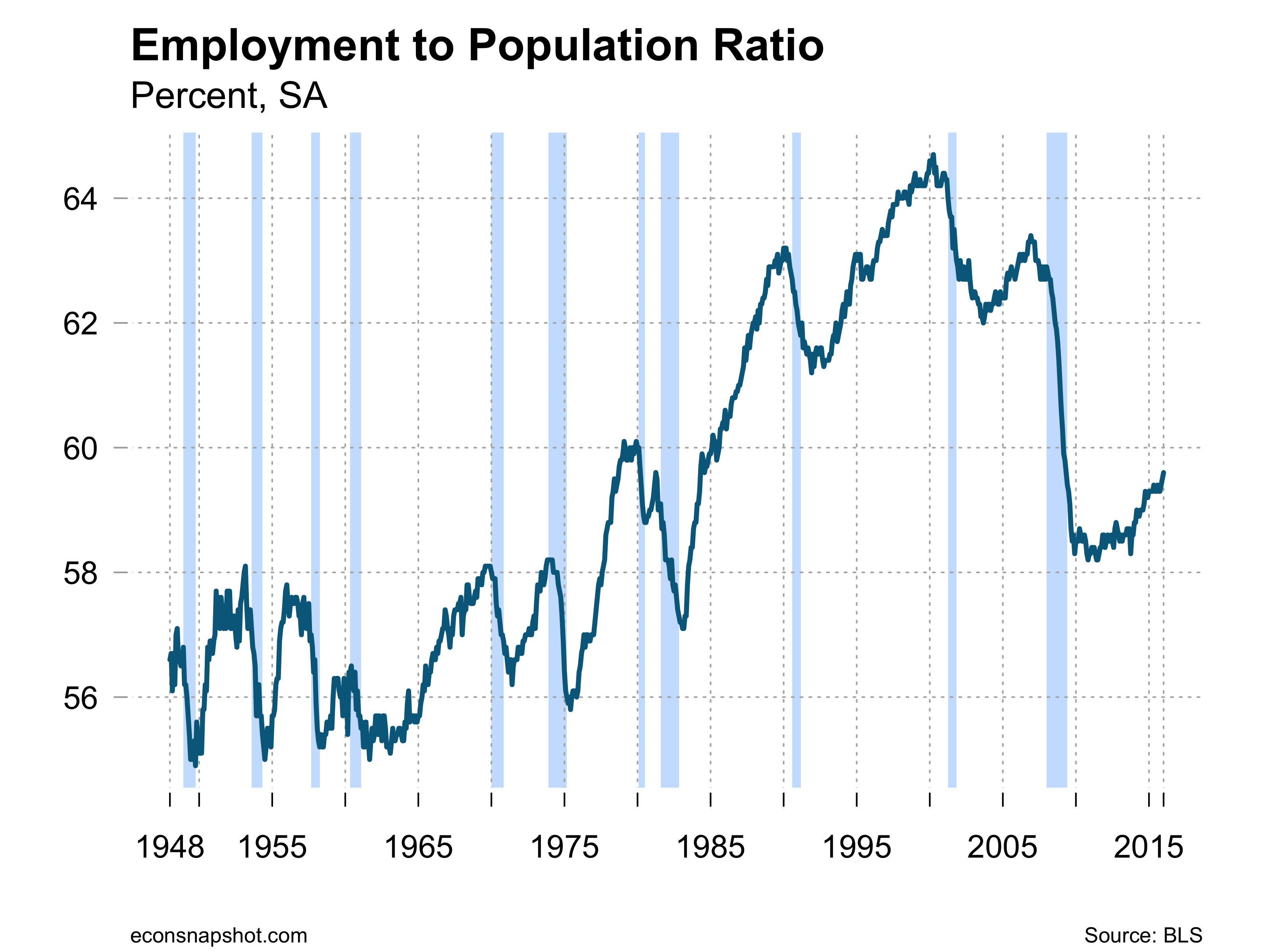
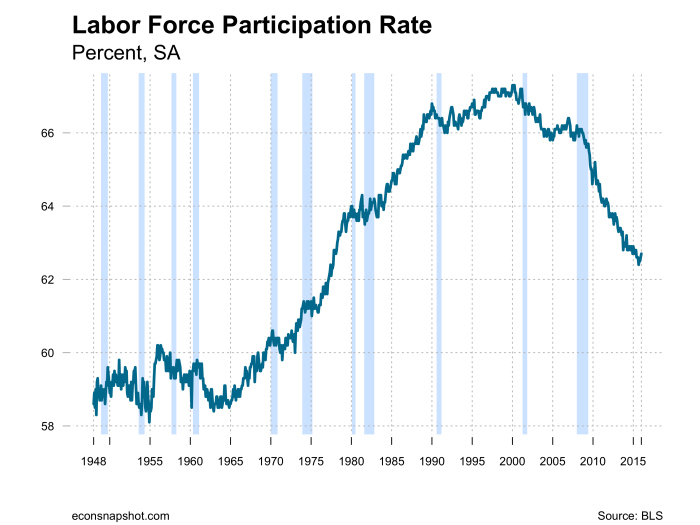
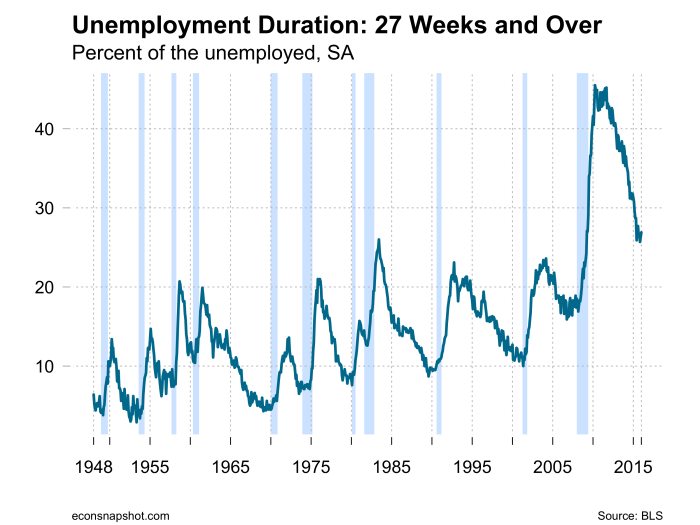
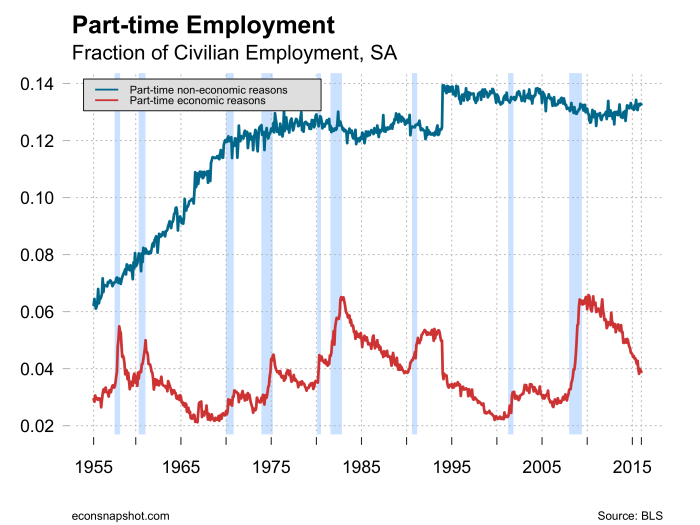
parttime-2015-12-04The household survey reveals very little significant change  over the past few months. The unemployment rate ticked up ever so slightly…from 5.036 to 5.046, but who’s splitting hairs. The participation rate also ticked up slightly and the employment to population ratio was essentially unchanged. The number of people working part time for economic reasons  popped up by 319,000 but it has been declining steadily for months.  The composition of the unemployed changed slightly with more more new-entrants to the labor force and more re-entrants.  The overall picture is of a recovered labor market with some continuing longer term structural issues.

unrate-2015-12-04

lfp-2015-12-04

unemp-composition-2015-12-04

epr-2015-12-04

parttime-2015-12-04


udur27-2015-12-04

Upward Revision to Q3 GDP…Yet Weakness in The Details

By Tom Cooley and Peter Rupert

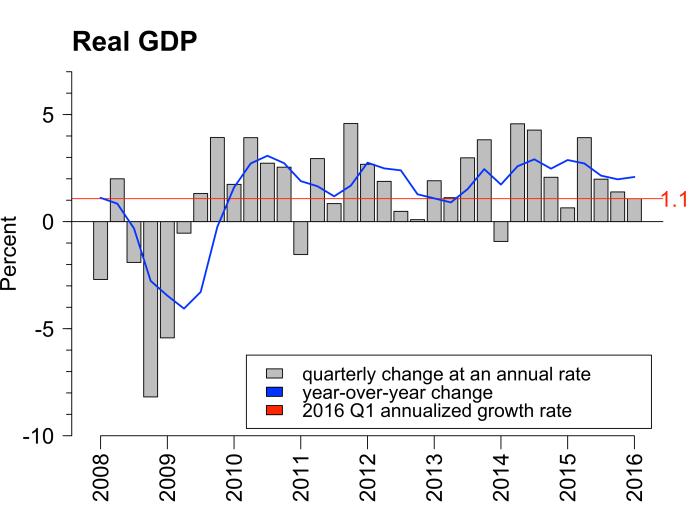
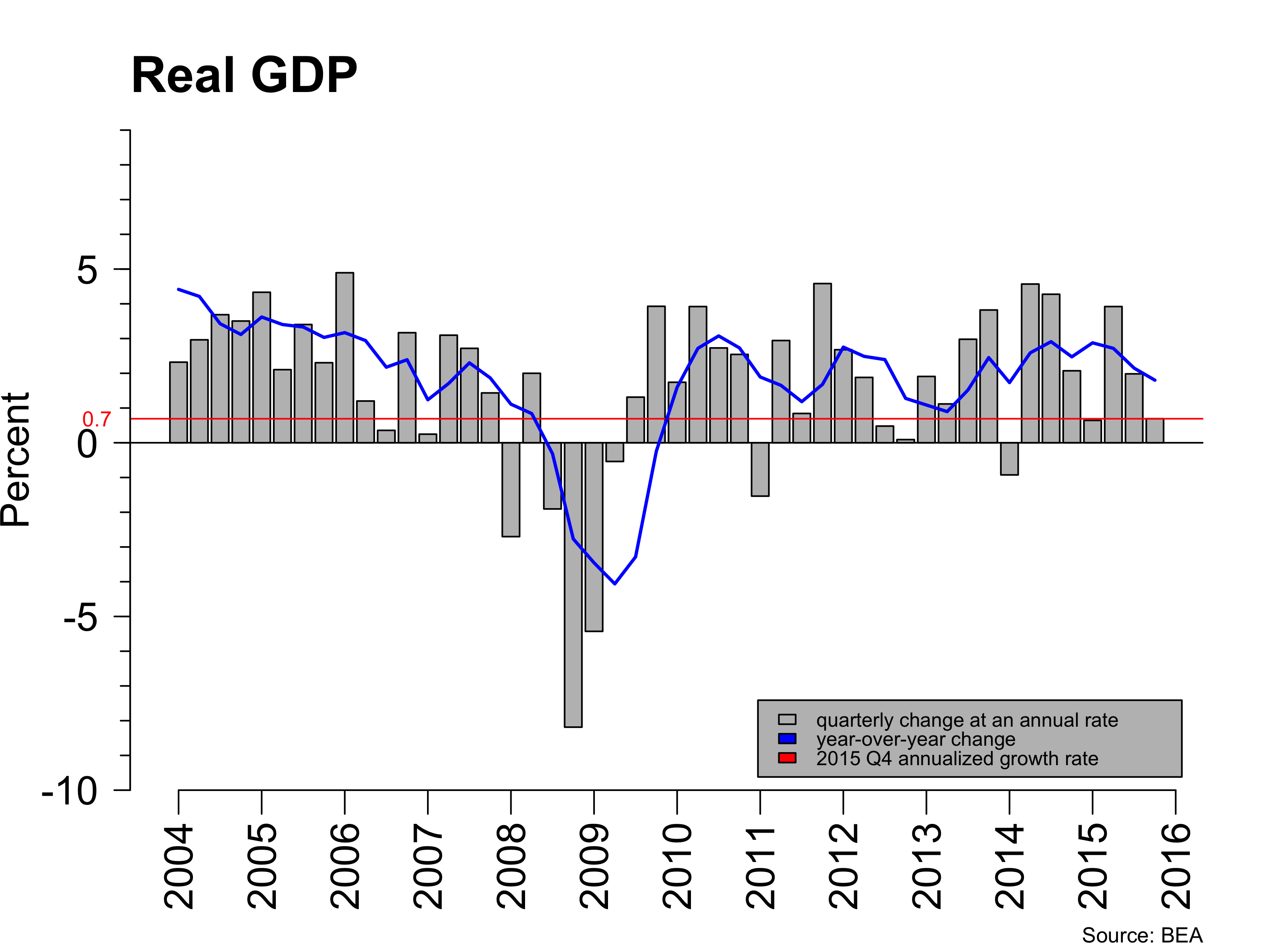
Today’s release of the second estimate for Q3 by the Bureau of Economic Analysis (BEA) reveals an upward revision from 1.5% in the advance estimate to 2.1% for real GDP.

gdprealchgm-2015-11-24

As pointed out in the release, “The upward revision to the percent change in real GDP primarily reflected an upward revision to
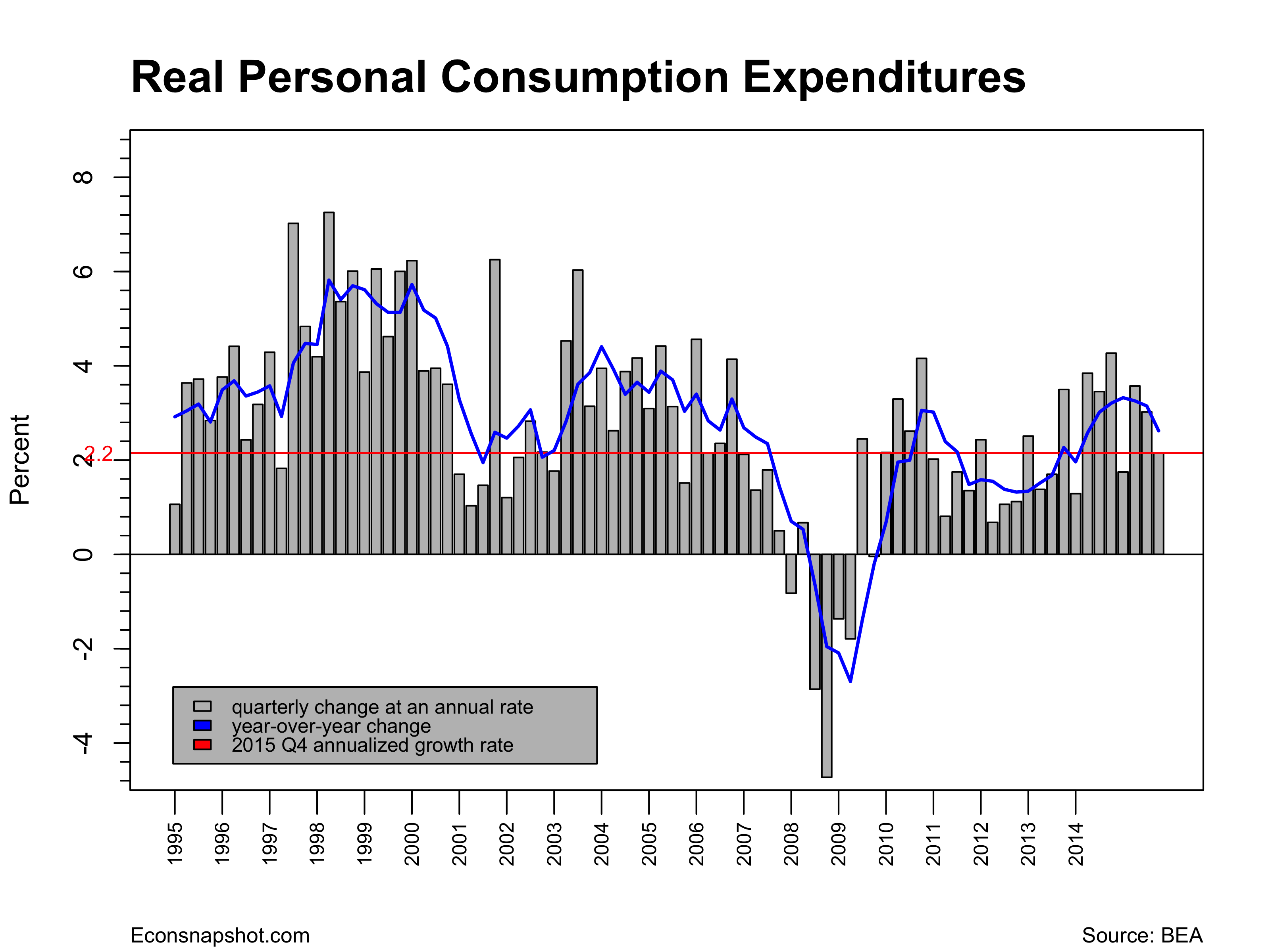
private inventory investment that was partly offset by downward revisions to PCE and to exports.” Personal consumption expenditure was revised down from 3.2% to 3.0%.  The weakness in consumption and the higher than anticipated inventory investment are signs of weaknesses that are confirmed elsewhere.

pcerealchgm-2015-11-24

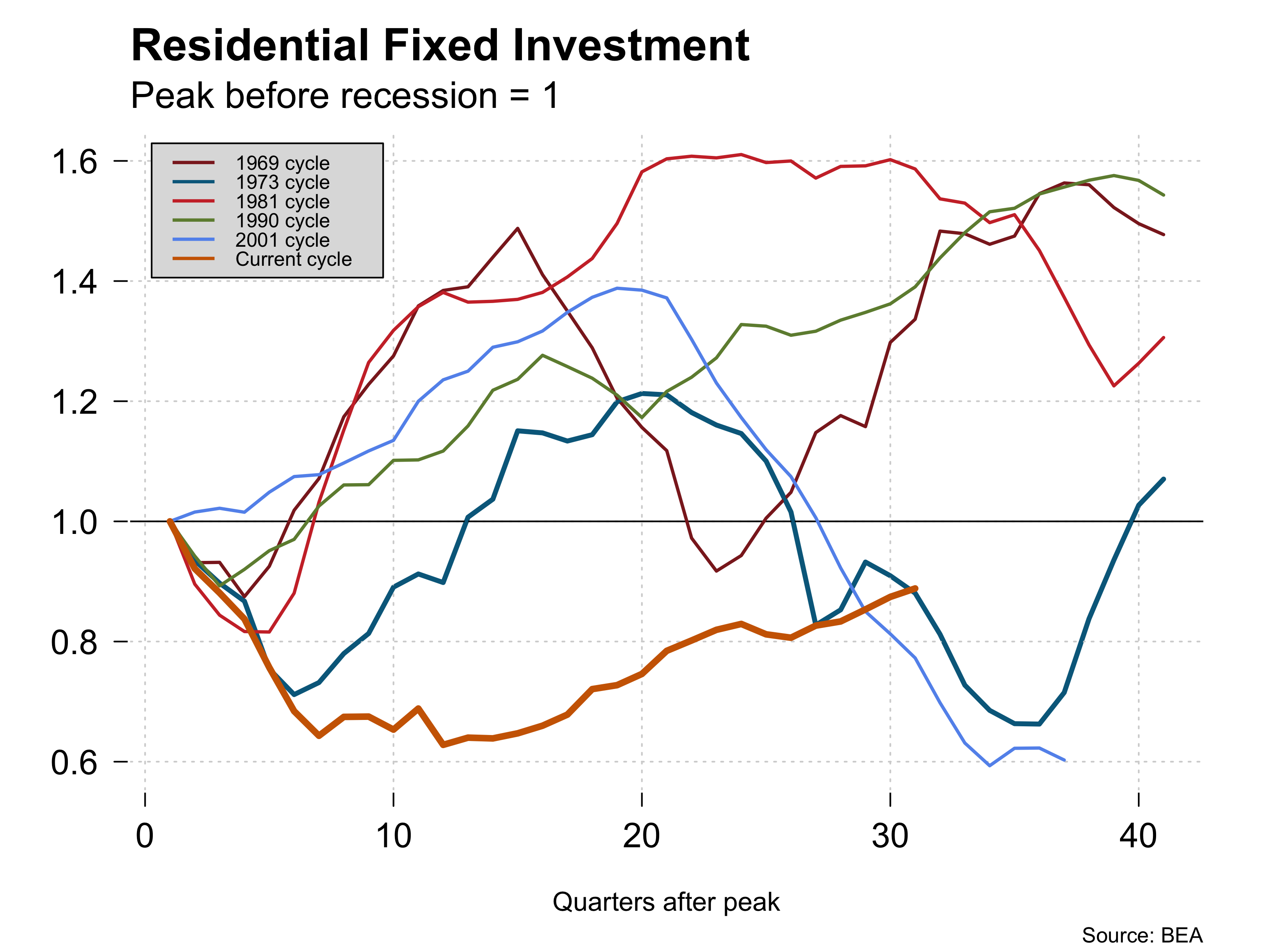
In our last post we mentioned that what looked like some bad news was not so bad. This time, what looks like good news with the upward revision reveals some troubling signs for the future path of interest rate hikes. It seems that the Fed will do what the Fed will do this December, as there is not much in the way of strong evidence to not raise rates at the next meeting and there is a strong desire to move off the zero lower bound. But weaknesses in the recovery are likely to affect the future path of the federal funds rate. Moreover, this is now quite a “mature” if tepid recovery, as can be seen in the first chart below –  other recoveries had expired this many quarters out.

gdp-cyc-2015-11-24

pce-cyc-2015-11-24

inv-cyc-2015-11-24

rfi-cyc-2015-11-24

nrfi-cyc-2015-11-24

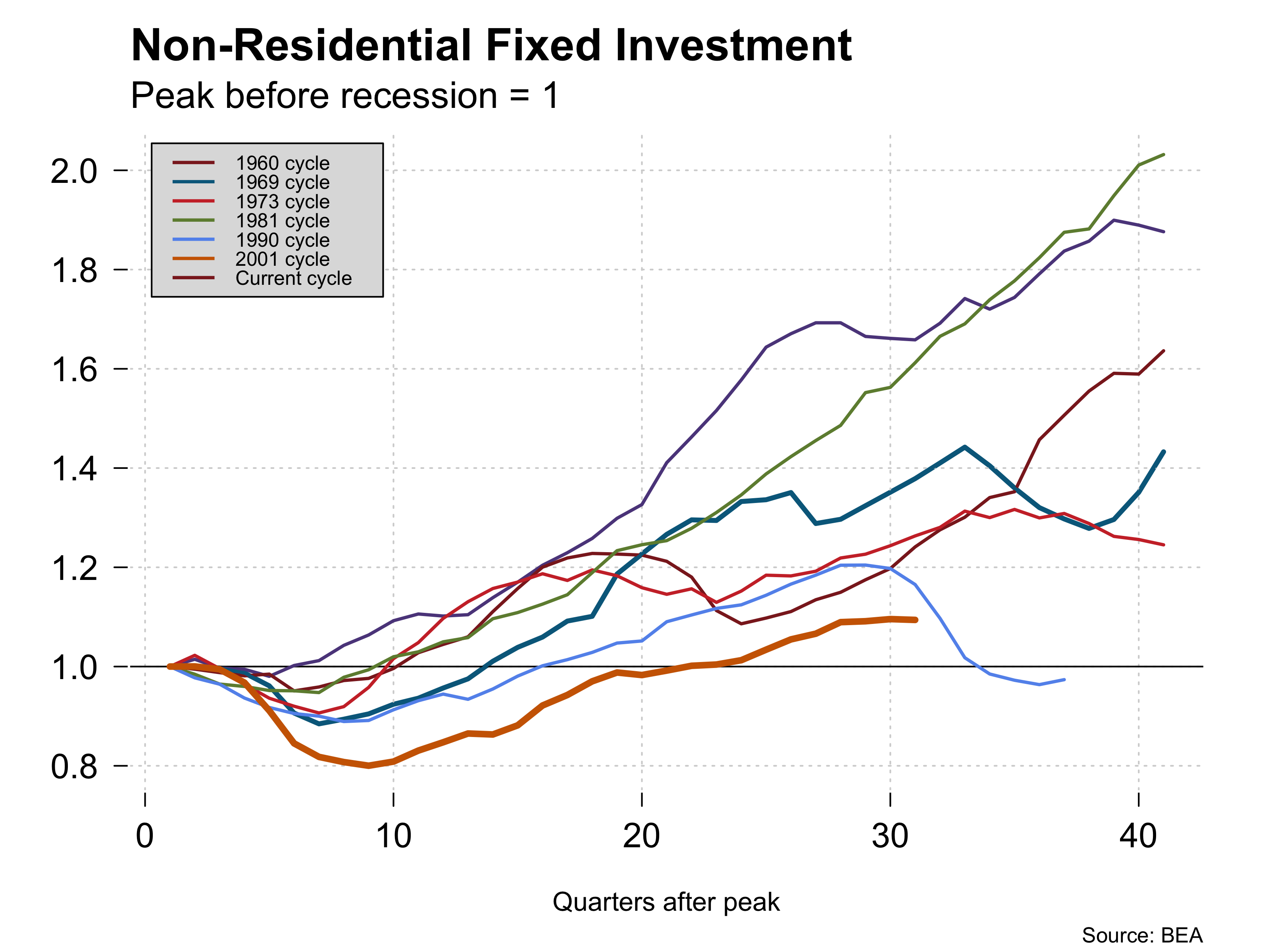
Consumption, investment and its components are all consistent with a continued, but weak, recovery; and this recovery is set in the context of a world economic order that is fragile and changing. Europe has continued to be slow to improve, Japan and China show signs of weakness and many emergent market economies are beset by the falls in commodity prices.

Weakness in Manufacturing

A strong dollar and aggressive monetary expansions elsewhere in the world have contributed to weakness in U.S. manufacturing.  Industrial production has been weak over the past year or so and capacity utilization continues to be below the estimated “boom-bust” level of 82.5.

indpro2015

tcu_fill


Barring a bad jobs report, the weakness in manufacturing is not likely to constrain the Fed from raising rates at its next meeting.  But along with other factors it is likely to constrain the path of interest rates for some time to come.

The Labor Market Recovery Continues

By Thomas Cooley and Peter Rupert

The preliminary establishment data released by the BLS for October shows strength  across the board in the labor market. Employment rose by 271,000 in October, and 268,000 of those were in the private sector.  Average weekly hours increased, the employment population ratio increased and the labor force participation rate stayed flat, although these two measures remain at historically low levels.

empchgm-2015-11-06

avghours-index-2015-11-06

epr-2015-11-06

lfp-2015-11-06

Earnings and Productivity

Another encouraging sign is that average hourly earnings and productivity both increased slightly, suggesting that competitive forces are beginning to assert themselves.

compensation-cyc-2015-11-06

prod-cyc-2015-11-06

The Unemployed and The Underemployed

In addition to the improving jobs and compensation numbers there is evidence that  long duration unemployment is declining and the numbers of those that are employed part-time for economic reasons are declining.

udur27-2015-11-06

parttimefrac-2015-11-06

The Labor Market and the Fed

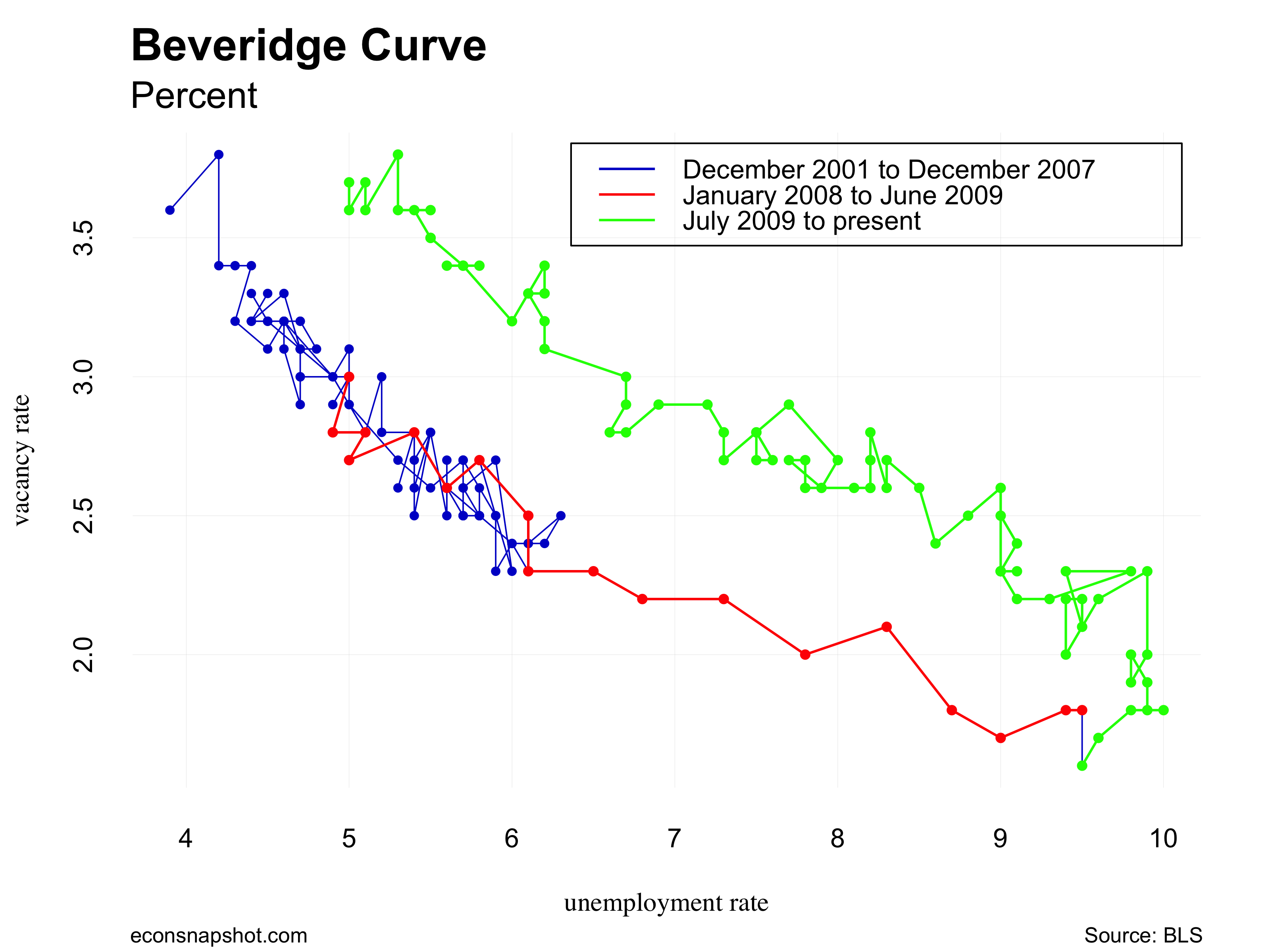
The business press and economic pundits all view this strong jobs report as erasing one of the remaining justifications for the Fed’s reluctance to normalize monetary policy and begin raising rates. That may very well be true but it doesn’t mean that the labor market has emerged from the long shadow cast by the great recession. The recession inflicted lasting damage to the labor market, damage that is revealed in the continuing low participation rates and more importantly in the deterioration of the market’s ability to match workers with jobs as is suggested by the outward shift in the Beveridge Curve for the U.S.  These problems are long term and structural and not likely to be solved by monetary policy.

beveridge-2015-11-06

It May Sound Disappointing But It’s Not!

By Thomas Cooley and Peter Rupert

The Bureau of Economic Analysis released the advance estimate for GDP the day after the October meeting of the FOMC. Kind of bad timing…would the FOMC statement have been the same after knowing GDP in the 3rd quarter increased by just 1.5%? Most prognosticators expected a large drop in GDP growth compared to Q2, so the weakness was not entirely unexpected. In fact the fundamentals of the GDP report were not disappointing at all if you look at the composition and were not so far off Q2 results. But, markets will take some time to digest what it all means and what it means for liftoff. The way we read the numbers, there is very little reason for the “data driven” Fed to wait.

gdprealchgm-2015-10-29

While the headline GDP growth number was lower than in Q2, the components of final demand were strong. Personal consumption expenditures grew at a 3.2% clip after climbing 3.6% in Q2. The contribution of gross private domestic investment to GDP growth fell by .9%, caused by a small decline in nonresidential structures and a big decline in inventories. Weaker exports were also a factor.

gdp-cyc-2015-10-29

pce-cyc-2015-10-29

nrfi-cyc-2015-10-29

What next?

It is clear that the U.S. economy is continuing to grow. That consumption and basic investment are strong is a sign that the domestic fundamentals are pretty strong. Real disposable personal income increased by 3.5%. Declines in the energy sector have held back investment in non-residential structures and equipment and that doesn’t promise to improve in the near future.  Most of the uncertainty and worry are  external. The biggest worry is about the much discussed slow-down in China and the knock-on effects that has for other commodity exporting nations like Brazil and Australia, as well as continued slow growth in Europe and Japan.  The world economy is not booming and that raises the legitimate question of what our expectations should be and what considerations should guide Fed policy. At the moment they seem to be operating on the basis of a “first do no harm” principle. There is a growing chorus of people who believe that they are doing unseen harm by not normalizing monetary policy. There will be a couple more employment reports and the second estimate of Q3 GDP before the next FOMC meeting in mid-December, so time and data will tell!

Do these data surprise the Fed?

By Thomas Cooley and Peter Rupert

Today’s release of the employment situation shows a modest increase in employment of 142,000. Moreover, employment over the past two months was revised down by a total of 59,000 (22,000 for July and 37,000 for August). While the mining and logging sector (oil) continued to shed jobs, manufacturing employment was down for the second month in a row; falling 9,000 in September after falling by 18,000 in August. Although the housing sector has shown some growth, construction employment is still lagging. Average weekly hours also fell back to 34.5.

empchgm-2015-10-02

emp-mining-support-2015-10-02

emp-manufacturing-cyc-2015-10-02

emp-construction-cyc-2015-10-02

avghours-2015-10-02

The household survey also had a weak flavor to it. The unemployment rate stayed at 5.1%, but the labor force fell by 350,000. The employment to population ratio also fell to 59.2.

unrate-2015-10-02

lfp-2015-10-02

epr-2015-10-02

Last week, the third “estimate” of real GDP for the 2nd quarter of 2015 shows  that output of final goods and services grew by 3.9% at an annual rate compared to 3.7% from the 2nd estimate. There was no change in the final estimate of 1st quarter GDP, remaining at 0.6%.  Personal consumption expenditures (PCE) was the largest contributor, providing 2.42 percentage points of the 3.9% gain.

gdprealchgm-2015-09-25

pcerealchgm-2015-09-25

Chairperson Yellen’s remarks on September 24 mentions again that they could (expect to?) raise rates by the end of the year:

Most FOMC participants, including myself, currently anticipate that achieving these conditions will likely entail an initial increase in the federal funds rate later this year, followed by a gradual pace of tightening thereafter. But if the economy surprises us, our judgments about appropriate monetary policy will change.

The last sentence in the Yellen quote once again provides an out for the Fed not to do anything. It is the nature of the beast that quarterly or monthly outcomes can be much different from the trend without signaling a change in direction. That is, if in the next employment report there is a slight uptick in the unemployment rate, or an employment change of say only 100k workers, will that dissuade members of the committee? There is (almost) always something in a given report, GDP or employment, that can be read as surprising. Perhaps non-residential investment is particularly low, for example. Here are the numbers for the annualized percentage change in non-residential structures over the past six quarters, i.e., starting in 2014Q1: 19.1%, -0.2%, -1.9%, 4.3%, -7.4%, 6.2%. And this for equipment over the same time period: 3.5%, 6.5%, 16.4%, -4.9%, 2.3%, 0.3%.

The bigger question is whether the economy is in a sustained recovery or have we hit a rocky spot giving the Fed further pause? That said, a return to normal monetary policy that begins to eliminate some of the distortions caused by several years of zero interest rates would seem to be beneficial and it is surprising that the FOMC did not see it that way.

No Excuses…Or Are There?

by Peter Rupert

The moment of truth concerning liftoff is upon us as the FOMC makes their decision and delivers their verdict tomorrow. With the release of the latest Job Openings and Labor Turnover Survey (JOLTS) and the previous employment report, it appears the labor market is firing on many, if not all, cylinders. The JOLTS data reveal both the highest level (about 5.7 million vacancies) and rate (3.9%) of job openings since the series began in December of 2000.

joltsjol-2015-09-15

joltsjor-2015-09-15

The unemployment rate is also quite low and the Beveridge Curve (a plot of vacancies vs. unemployment) is now looking much healthier after its typical counter-clockwise journey. Many of the previous statements from the meetings suggested that there was still some slack in the labor market, but it was dissipating. With vacancies as high as ever it appears that businesses are in hiring mode big time…but, inflation is not in sight.

unrate-2015-09-15

beveridge-2015-09-15

ahecpi-2015-09-15

So, the question is: When is the right time? Financial markets are volatile for sure; however, to what extent has Fed policy fed into the volatility? The rest of the world has its problems, but many areas will continue to be problematic for some time to come, see our commentary here.

If the FOMC does not raise rates today, here is what they will likely say: “While labor markets appear to have reduced slack, there is little evidence of inflation. The rest of the world is still in turmoil.” And if they do raise rates, “Labor markets have continued to recover and are now near levels thought to be in the target range. While global markets are still somewhat fragile, the evidence in the US suggests that the current stance of policy is not in line with normal policy.”

August Employment…Keeps US Guessing

by Tom Cooley and Peter Rupert

The Bureau of Labor Statistics establishment survey for August revealed a somewhat expected, yet somewhat disappointing, 173,000 employment increase. Upward revisions totaling 44,000 over the past couple of months took some of the edge off of the disappointment. Private employment posted only a 140,000 gain, however, and government continued to climb, up 33,000. Goods producing declined by 24,000, with manufacturing down 17,000 and mining and logging down 10,000. Given the tendency for the August numbers to be revised upwards this report is in keeping with previous months and is not likely a sign of weakness in the economy.

empchgm-2015-09-04

empuspriv-2015-09-04

empgovt-2015-09-04

Hours and Wages:

The average workweek ticked up to 34.6 after three consecutive months at 34.5. Average hourly earnings were also up slightly.

avghours-2015-09-04

ahe-2015-09-04

Participation:

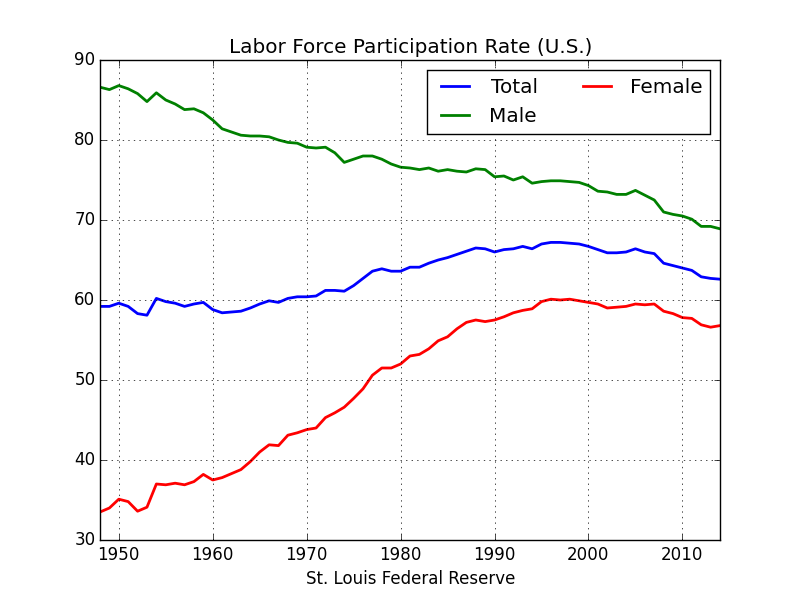
From the household survey, the number of unemployed fell by 237,000; however, the labor force was also down, 41,000, leading to a decline in the unemployment rate to 5.1% and no change in the labor force participation rate at 62.6. This is really the major conundrum for the U.S. economy. Labor force participation is at a forty year low. The employment to population ratio has picked up slightly but not anywhere near enough to reverse the precipitous drop during the Great Recession.  The low participation rates suggest there are many workers who have been effectively disenfranchised by the Great Recession which continues to cast its long shadow over the economy.  But these are now structural issues not cyclical ones.

lfp-2015-09-04

epr-2015-09-04

The number of people unemployed less than 5 weeks fell by 393,000 while the number unemployed 27 weeks or more rose 7,000; again showing that the issues seem more structural than cyclical.

udur27-2015-09-04

Strong GDP Revision Amid Market Turmoil

by Thomas Cooley and Peter Rupert

The past week has been a wild and crazy ride, capped by a strong GDP report, boosting Q2 growth from the advance estimate of 2.3% to 3.7%. This morning, the personal income release reveals personal income growth of 0.4% for July, the same growth rate as the previous three months. The week began with a Dow drop of about a 1000 points during the morning, but closed down “only” 588 points (-3.57%)…followed by -1.29% on Tuesday, +3.95% on Wednesday, +2.27% on Thursday. That turmoil was puzzling given that most observers saw the U.S. economy as fundamentally strong even before the latest update of Q2, with low unemployment and steady growth in real output.

gdprealchgm-2015-08-28

That the economy has grown steadily, albeit slower than during other recoveries, has given monetary policy makers the opportunity to begin to normalize operations. However, given the length of the recovery, are some now worried about another possible dip…as seen in the 1973 and 2001 cycles below?
gdp-cyc-2015-08-28

pimonth-2015-08-28

The fundamentals of this recovery are strong as well. Consumer spending growth was up 3.1% and has been strong for the past year.

Investment, particularly intellectual property investment was strong.

pce-cyc-2015-08-28


inv-cyc-2015-08-28


What Next for The Fed?

The market turmoil of last week led many, including William Dudley , President of the New York Fed, to call for caution in normalizing monetary policy and beginning “liftof”as many expected them to do at the September meeting.  Why the turmoil in markets should cause them be cautious is a puzzling question because it can be argued with some credibility that the state of financial markets has been significantly distorted by the Fed’ policy of the last seven years.  It is even more bizarre to see former Treasury Secretary Larry Summers calling for more asset purchases by the Fed. The fact of the matter is that the U.S. economy is looking extremely normal with low unemployment, steady job growth, and decent growth in real GDP in spite of significant headwinds from the rest of the world and a strong dollar.  If now is not the time to return to normal monetary policy, when will be?

Labor Market Remains Solid

By Tom Cooley and Peter Rupert

The employment report released today by the BLS was in line with expectations and so no surprises anywhere to speak of.

Establishment Survey

The establishment survey reveals total nonfarm payroll employment increased by 215,000 in July; both May (+6k) and June (+8k) were revised up slightly from the previous estimate, although the average monthly gain for the previous 12 months is 246k. While employment growth has remained steady, though slightly below its 12 month average, today’s report appears to keep the Fed on track for liftoff…most likely in September.

empchgm-2015-08-07

Average weekly hours ticked back up to 34.6 after four straight months at 34.5. Average hourly earnings for all employees on private nonfarm payrolls rose by 5 cents to $24.99, up 2% over the past 12 months.

avghours-2015-08-07

ahecpi-2015-08-07

Household Survey

The household survey conveys a slightly weaker picture of the labor market. Household employment grew only 101k. Moreover, the increase over the past five or six months has been much lower than that for the establishment survey. The unemployment rate was virtually unchanged as was the employment to population ratio and the labor force participation rate.

estabhouse-2015-08-07

unrate-2015-08-07

epr-2015-08-07

lfp-2015-08-07

The Fed

Overall, then, it appears that given the steady performance of the labor market and the commentary from various Fed folks: Atlanta Fed President Lockhart, “It will take a significant deterioration in the economic picture for me to be disinclined to move ahead.” And St. Louis Fed President Bullard, “We are in good shape,” to raise rates in September, leads one to believe a rate hike is quite likely. But here is where one should give pause.

What is the rush to start “liftoff” when there is so little evidence of inflation? One argument might be that keeping interest rates so low creates distortions, but those distortions have been in place now for several years and might be described as the new normal. The Fed of yore would have waited to see some signs of inflation. While many have latched on to the Summers’ quote about not raising rates until you see the whites of its eyes, it is not a new concept nor a new phrase. Alan Blinder said this in a Minneapolis Fed meeting back in 1995. His point then was that it takes time for monetary policy to work,( long and variable lags):

So what is a poor central banker to do? When you look at this set of difficulties—forecasts are not very good, theories and statistical evidence are much in dispute—it is tempting to say: Why don’t we just wait and see what happens? If inflation starts rising, hit the economy with higher interest rates. If unemployment starts rising, do the reverse. I call this the Bunker Hill strategy: Wait until you see the whites of their eyes and then fire. Why don’t we do that?

The answer is very simple: The Bunker Hill strategy will fail. It is sure to lead you into error because by the time you see the whites of their eyes, they’ve already shot you right through the heart.

Is this why the Fed today believes it should raise rates? If not, what is/are the reasons? The labor market has been steadily improving, but certainly has not been on fire. There are no signs of inflation anywhere, not current or expected. Wages have been fairly stagnant. Forward guidance and the Fed’s “threshold” unemployment number, 6.5%, have come and gone. The only explanation seems to be that there is a desire to return to normal monetary policy making and  rates have to go up at some point.

Tepid GDP Growth Could Keep The Fed at Bay

by Thomas Cooley and Peter Rupert

Today’s GDP report reveals Q2 growth of 2.3% for the advance estimate. Overall, this tepid increase provides is not going to be an inducement to hike rates at the next meeting of the FOMC. First quarter GDP was revised upward to 0.8%, better than the initial estimate of  a  -0.2% decline.

gdprealchgm-2015-07-30

But, as the above graph makes clear, the last three quarters do not show much evidence of robust growth. The bad news in the report is that second quarter growth was fueled in part by a big surge in inventories, a fact that could weigh on growth prospects in future quarters. Also discouraging was the downward revision to the longer term picture of GDP growth.

Annual Revision

Each year the BEA performs an annual revision, mostly covering the previous three years, but for some components goes back even farther. The result of the revisions show somewhat weaker growth compared to the previously published estimates. From the BEA release:

  • From 2011 to 2014, real GDP increased at an average annual rate of 2.0 percent; in the previously published estimates, real GDP had increased at an average annual rate of 2.3 percent. From the fourth quarter of 2011 to the first quarter of 2015, real GDP increased at an average annual rate of 2.0 percent; in the previously published estimates, real GDP had increased at an average annual rate of 2.2 percent during this period.
  • The percent change in real GDP was revised down 0.1 percentage point for 2012, was revised down 0.7 percentage point for 2013, and was unrevised for 2014.

Since the “end” of the recession in 2009 growth has been lackluster, although investment has experienced faster growth, having declined more dramatically as is usual over the business cycle.

gdp-cyc-2015-07-30

gdpconinv-2015-07-30

The FOMC and Moderate Growth

The recent policy statement from the FOMC used the word “moderate” twice in the first two sentences when talking about economic activity and household spending. As can be seen in the graphs above, both GDP and PCE grew in lock step over that past several years, and grew 2.3% and 2.9%, respectively for Q2.  The GDP price index grew at 2.0% (1.4% for the core) and the PCE price index grew at 2.2% (1.8% for the core PCE price index), all of them right around the 2.0% FOMC target. And, while they mentioned the housing sector has shown additional improvement, “business fixed investment and net exports stayed soft.”

pce-pi-quarterly-2015-07-30

Evidently, the FOMC is putting more weight on what happens in the labor market: “The Committee anticipates that it will be appropriate to raise the target range for the federal funds rate when it has seen some further improvement in the labor market and is reasonably confident that inflation will move back to its 2 percent objective over the medium term.”