GDP grows by 2.5% in first quarter advanced estimate

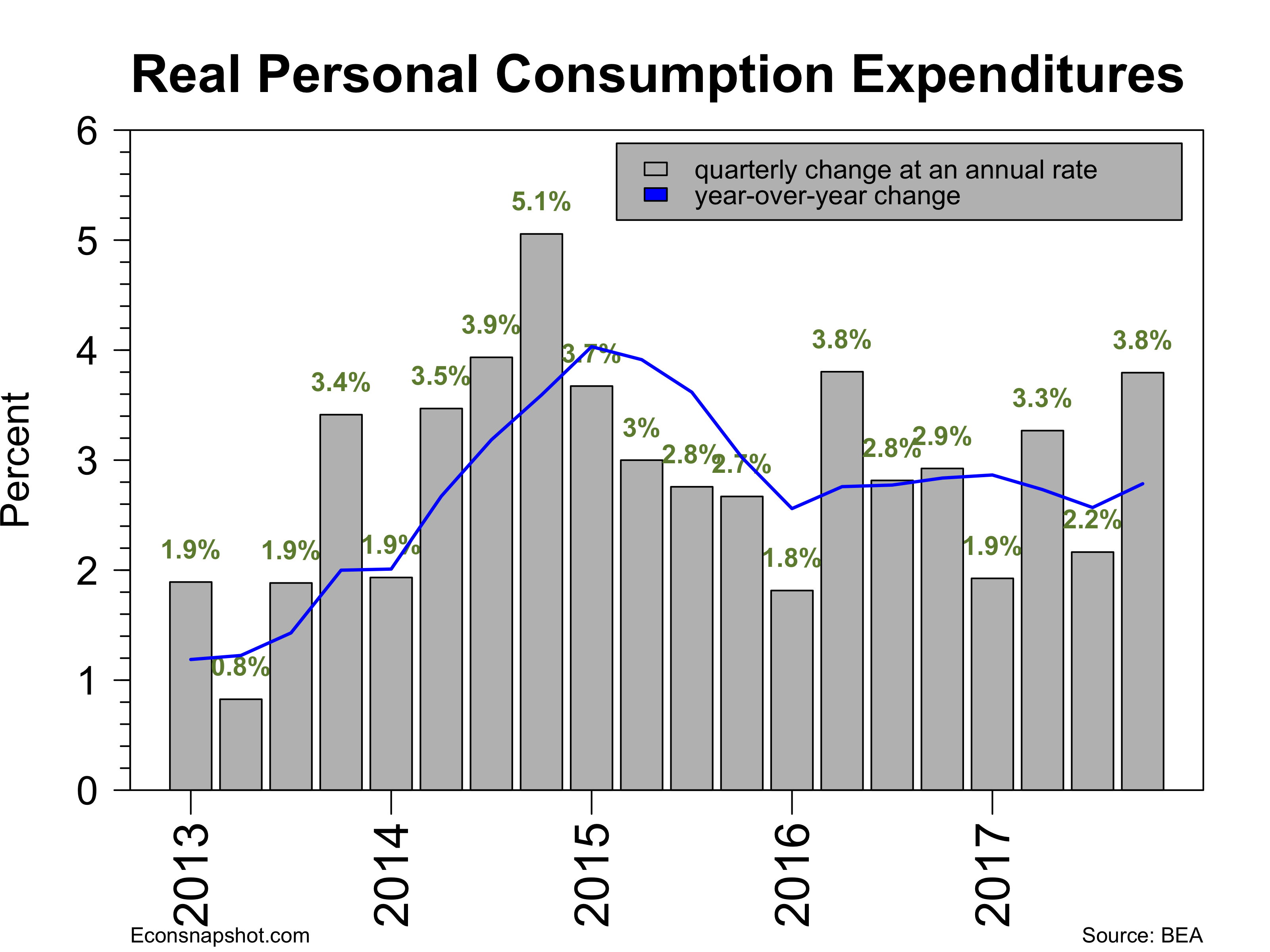
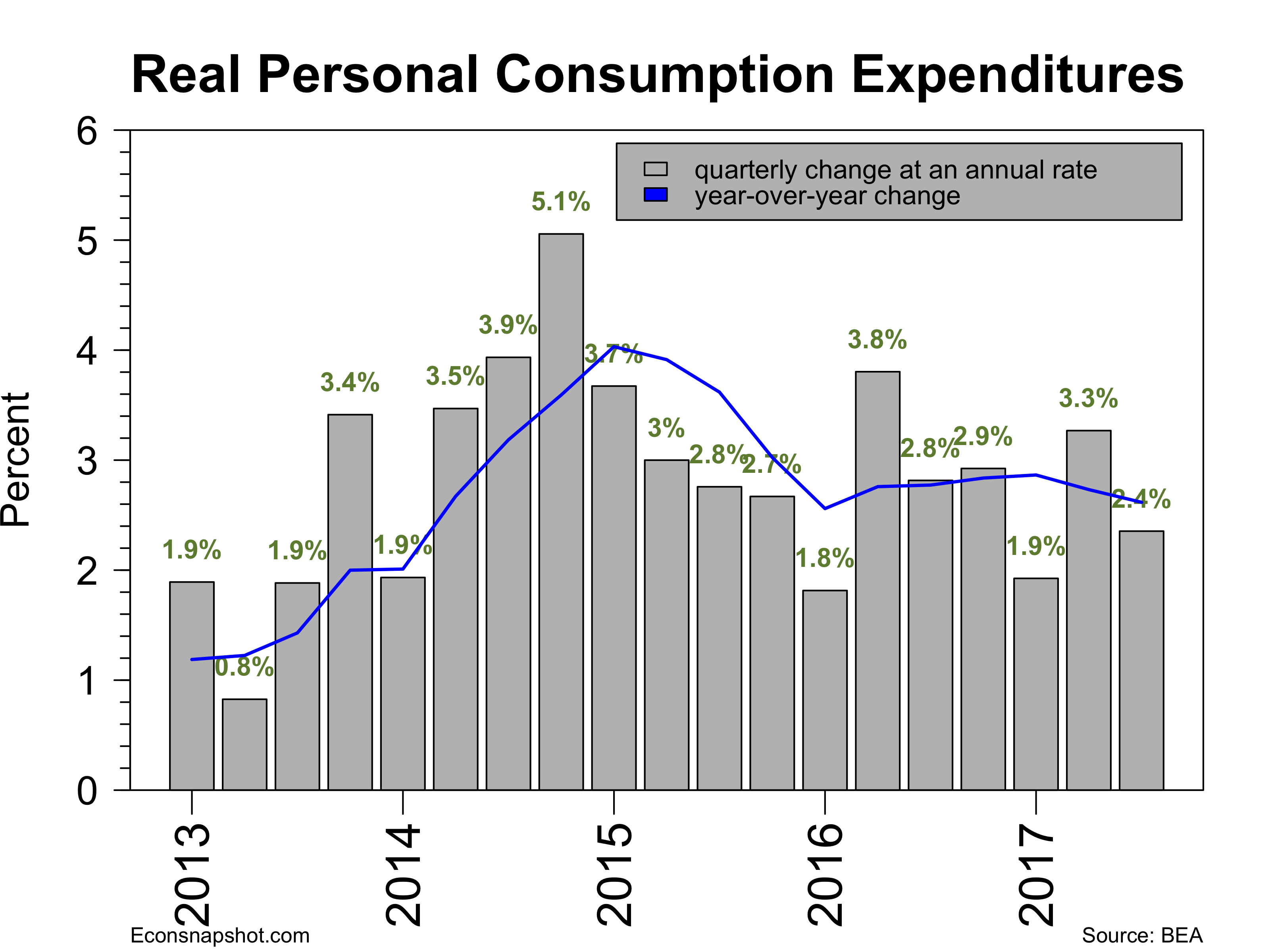
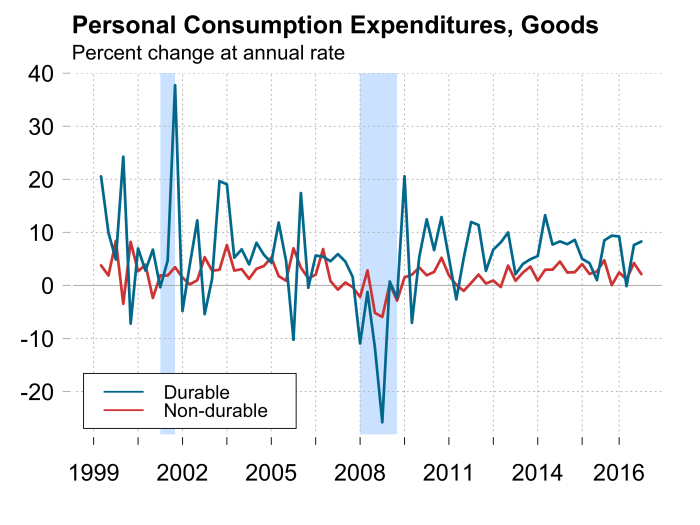
The Bureau of Economic Analysis announced here that real GDP increased by a seasonally adjusted annual rate of 2.5%. The increase was fueled largely by personal consumption expenditures (contributing 2.24 percentage points to the overall 2.5 percentage point increase).

rgdp-2013-05-03

cons-2013-05-03

What worked against the increase in real GDP growth was a large decline in government spending along with a big rise in imports.  Although this report represents yet another quarter of growth below the long run trend, it was positive growth in contrast to Europe which is sinking back into recession.

On the bright side, the economy continued to generate positive growth without the boost from Government spending.  Signs that housing markets contributed to the positive growth represent an encouraging phase in the recovery–historically, housing  has led the economy out of contractions.

govcons-2013-05-03

imports-2013-05-03

inv-2013-05-03

rfi-2013-05-03

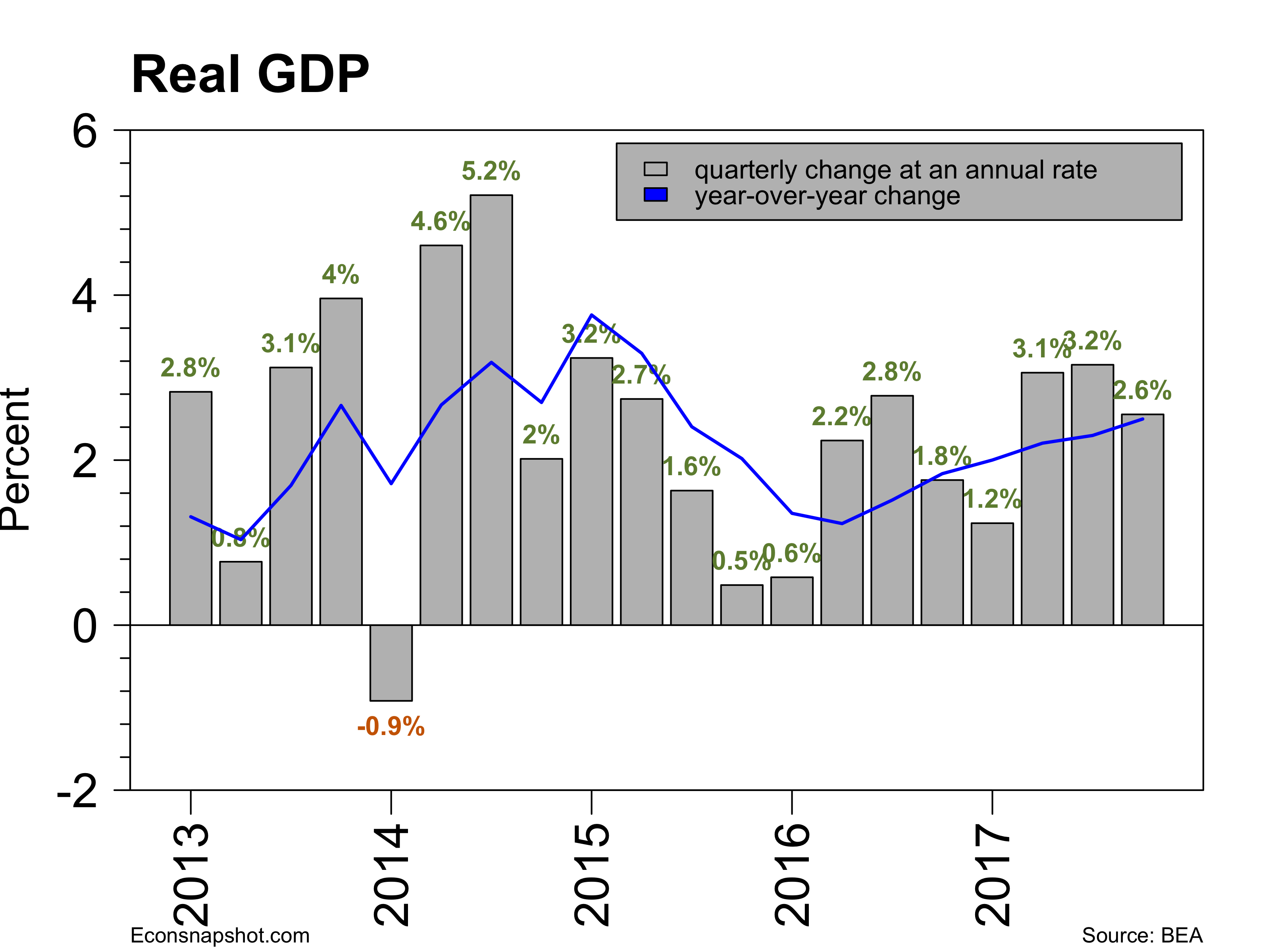
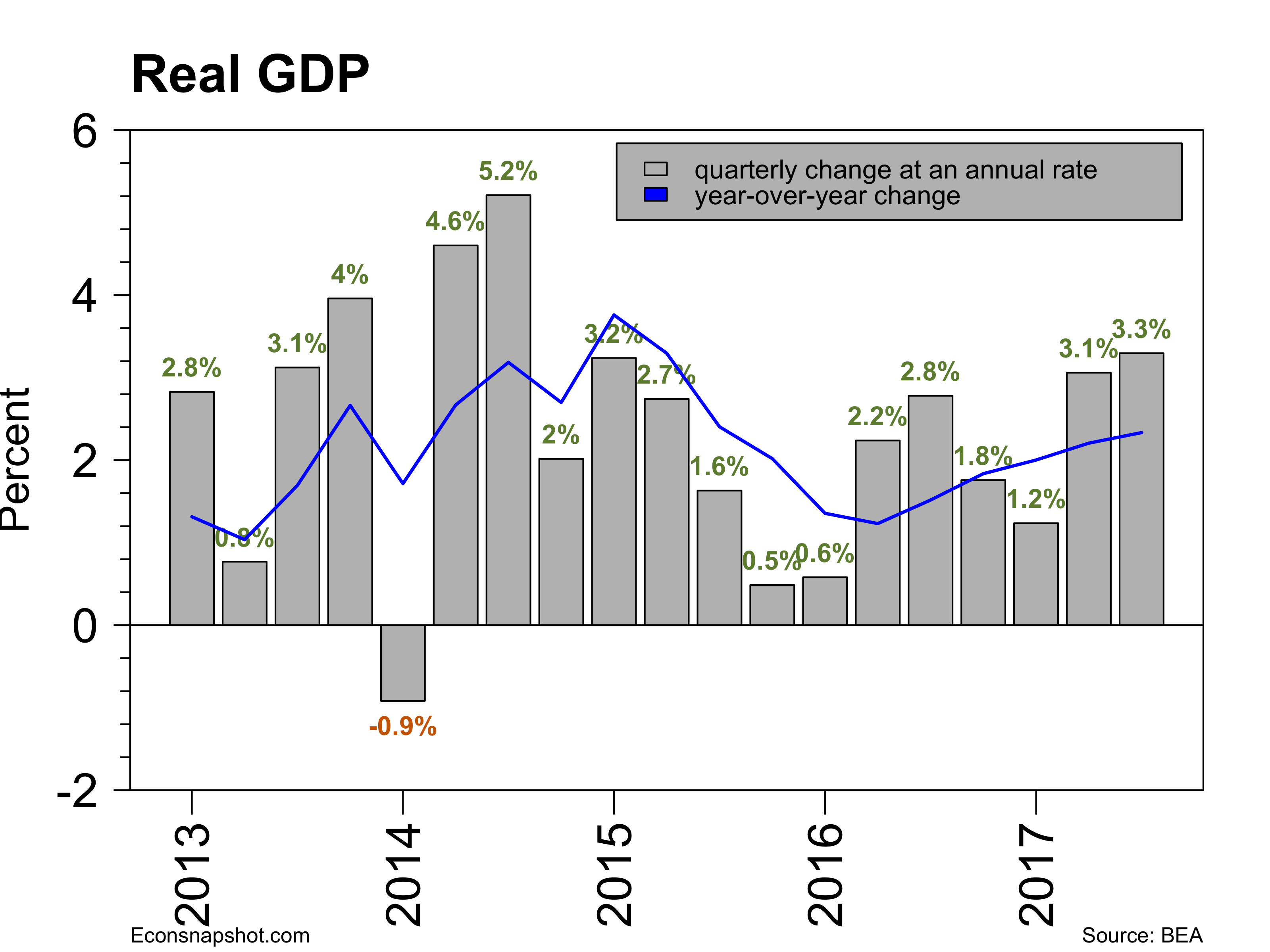
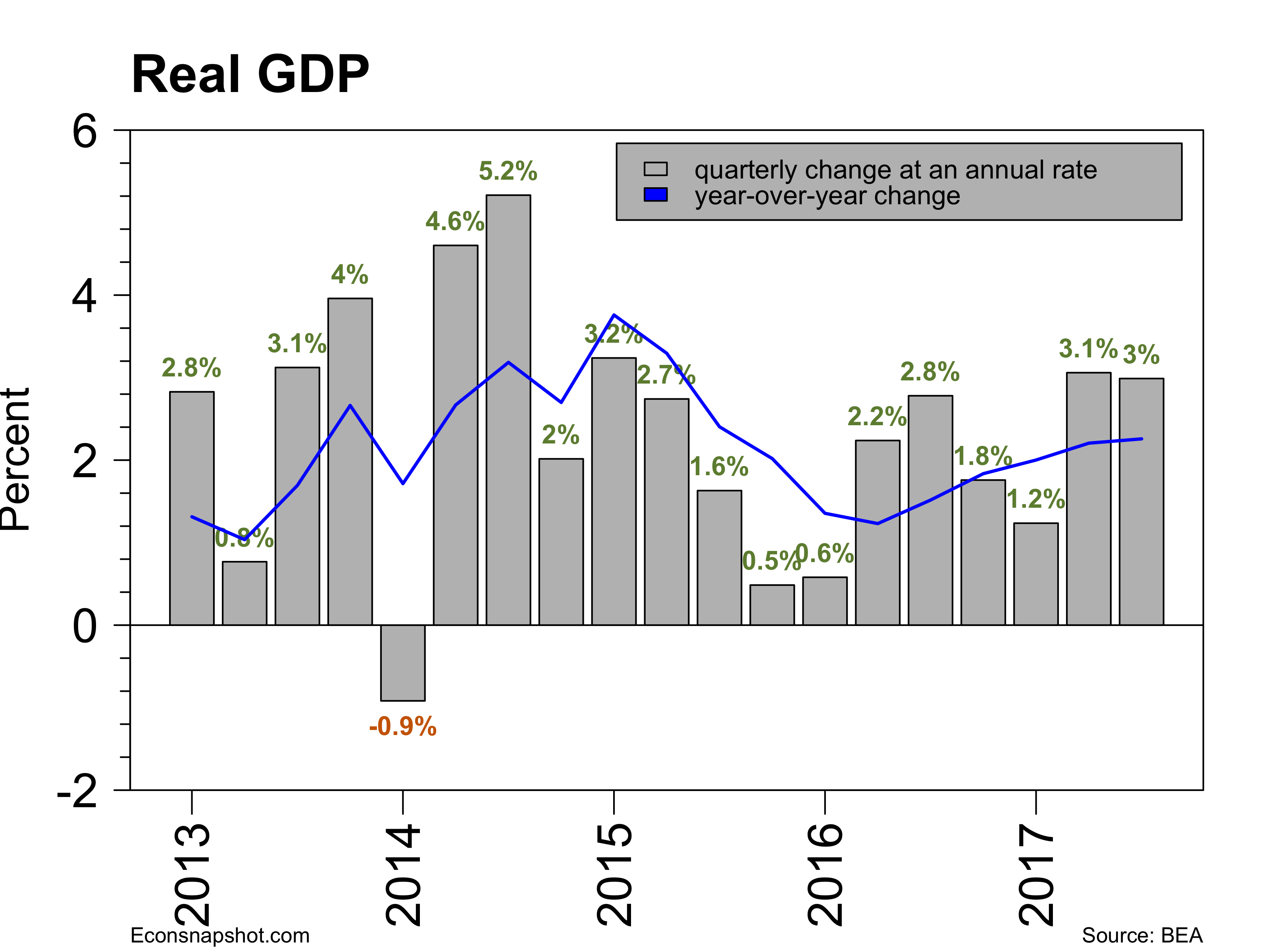
The bar graph shows another way of looking at the recent behavior of real GDP. The bars in the graph show the quarter-to-quarter change (s.a.a.r.) in real GDP while the blue line indicates the year-over-year change (s.a.a.r.). The first thing that stands out is the very large decline in real GDP during the last recession. The recession in the earlier part of the decade hardly looks like a recession at all in comparison. And, while the quarterly change in Q1 was 2.5%, the year-over-year change between 2013Q1 and 2012Q1 was 1.8%. Moreover there appears to be somewhat of a decline in the average year-over-year change: the average pre-2001 recession year-over-year change was higher than that in the years between the 2001 recession and the recession beginning in 2007 and that is higher than the recovery phase starting in June, 2009 (according to the NBER business cycle dates).

gdprealchgm-2013-05-05

An alternative way to think about long-term economic growth is to decompose real GDP into a trend component and movements around this trend, that is, the cyclical component of the business cycle.  Many economists use the Hodrick-Prescott (HP) filter to do this decomposition. The HP filter, however, has some issues that we have pointed out previously here about estimating the growth trend at the end of the data series.

If one believes we will eventually get back to 2% real growth, the trend line will be something like the dashed red line in the following two graphs. The green line represents the HP filter’s trend which equates to about 0.8% annual GDP growth.

2005 cutoff - trend

2005 cutoff - trend zoomed

The implication of this is that the recent recession and recovery will appear much worse if we believe that GDP will grow at 2% over the long term. The red dotted line in the graph below has shown no signs of returning to the historical trend, and won’t, as a long as the quarterly report consistently comes in below 2 percent. On the other hand, if you believe that the financial crises and Great Recession inherently altered the growth potential of the US economy and that the long-term growth trend has shifted down, as the green line shows, then the recovery doesn’t look nearly as anemic. In fact, with this view GDP has already recovered and is above trend.

Many may be aware of what has been called the Great Moderation, a period where the volatility of real GDP declined markedly–between the mid 1980′s and 2007. While some have mentioned that this may be the result of better policies, the recent episode may suggest that the great moderation was nothing but a series of smaller, or less consequential shocks.

2005 cutoff - cyclical deviation zoomedIf one believes that we will once again move to the sustained 2% growth path, then the graph above leaves plenty of room for concern in the short-term.

March Employment Report Underwhelms

Meager growth in employment

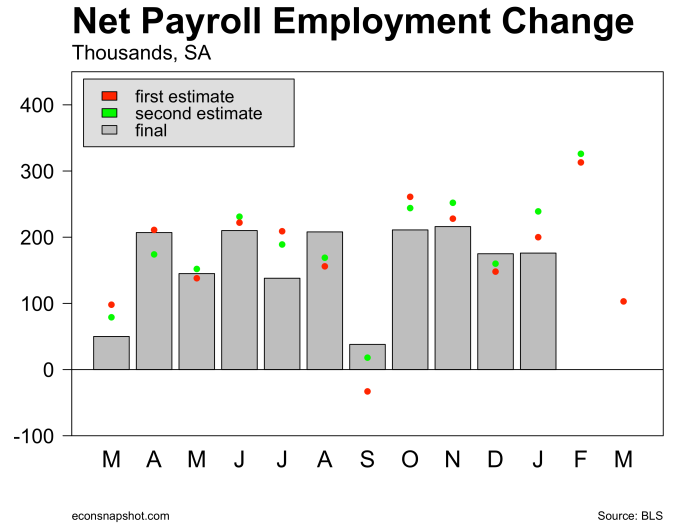
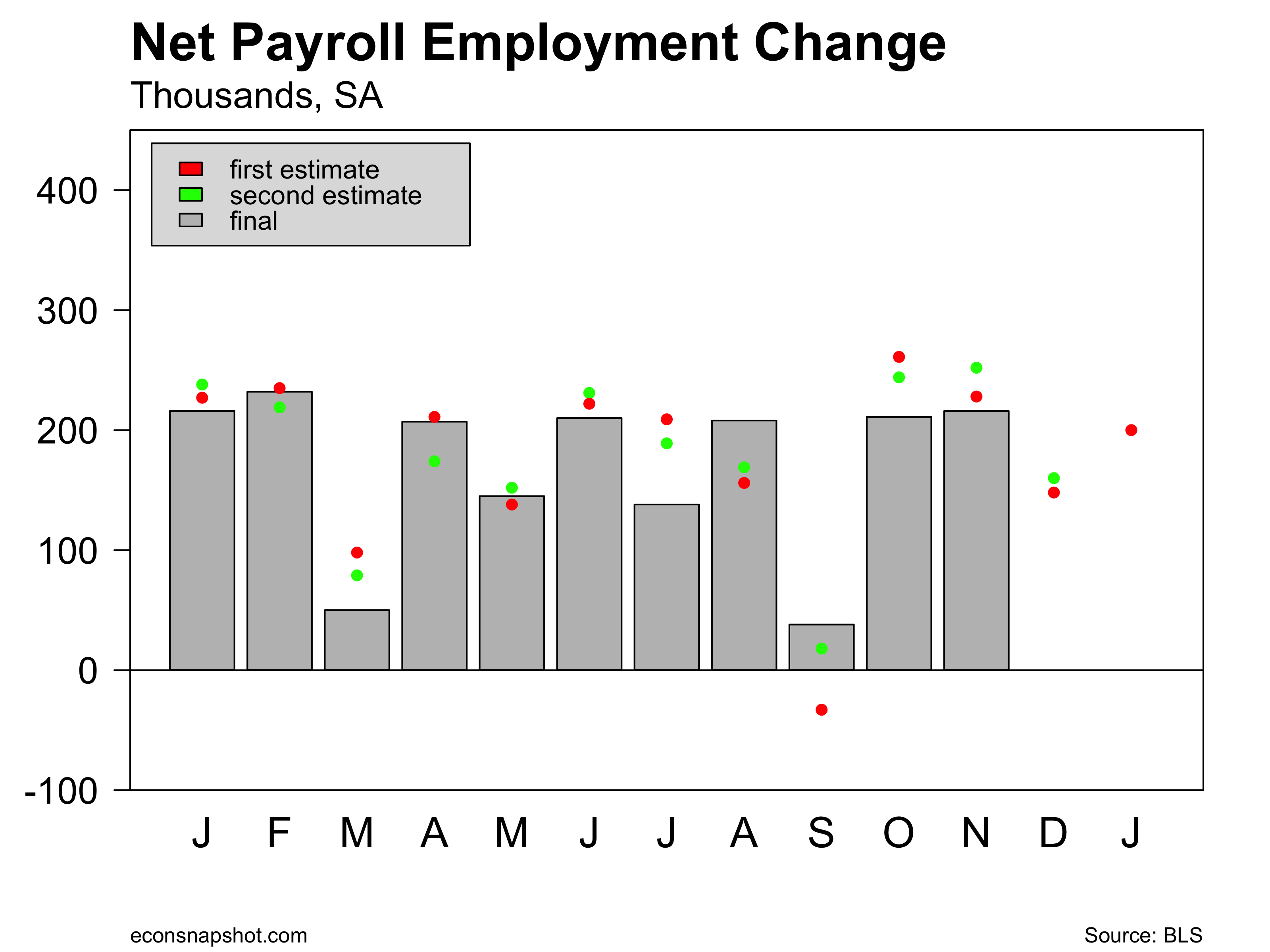
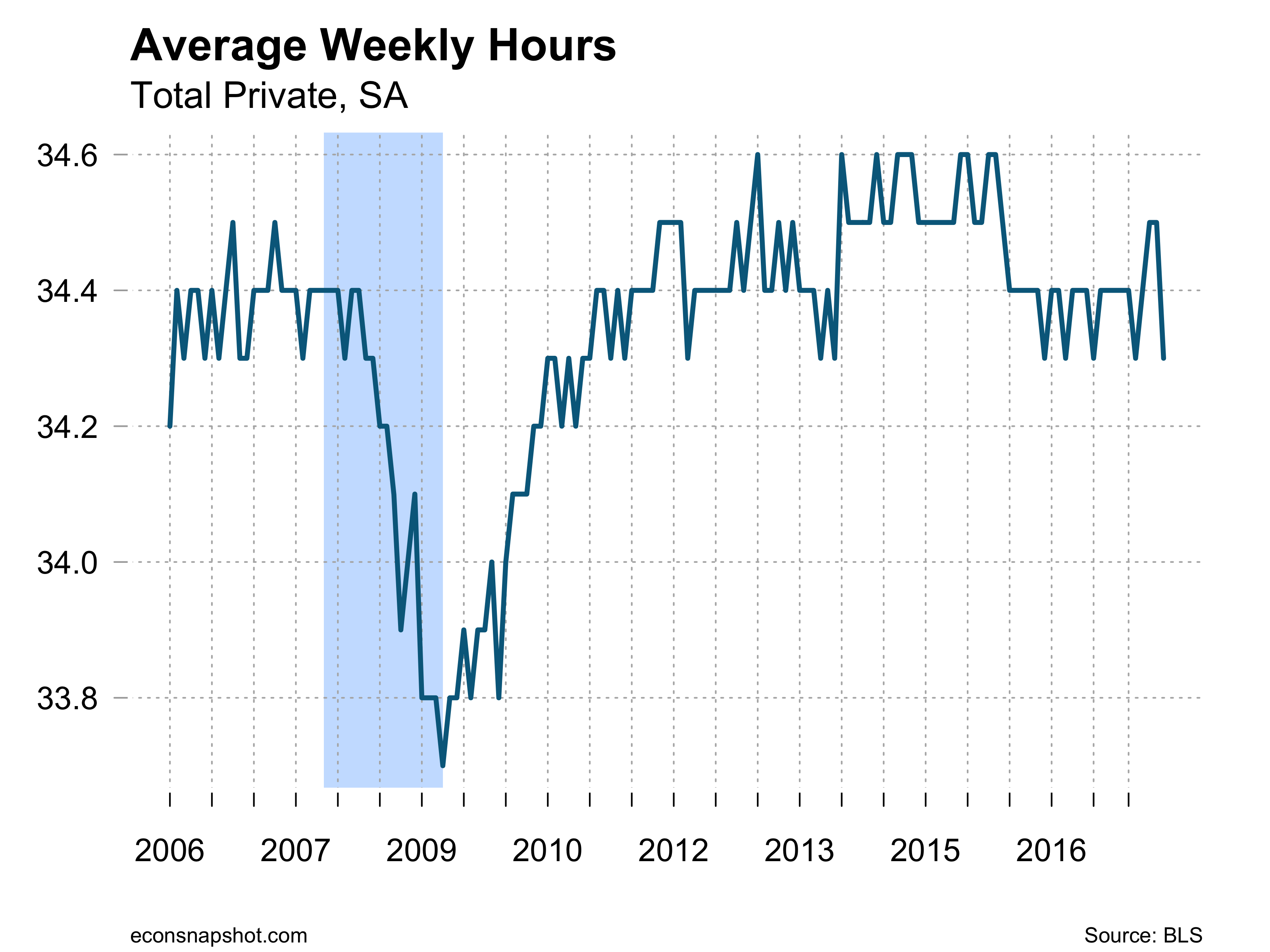
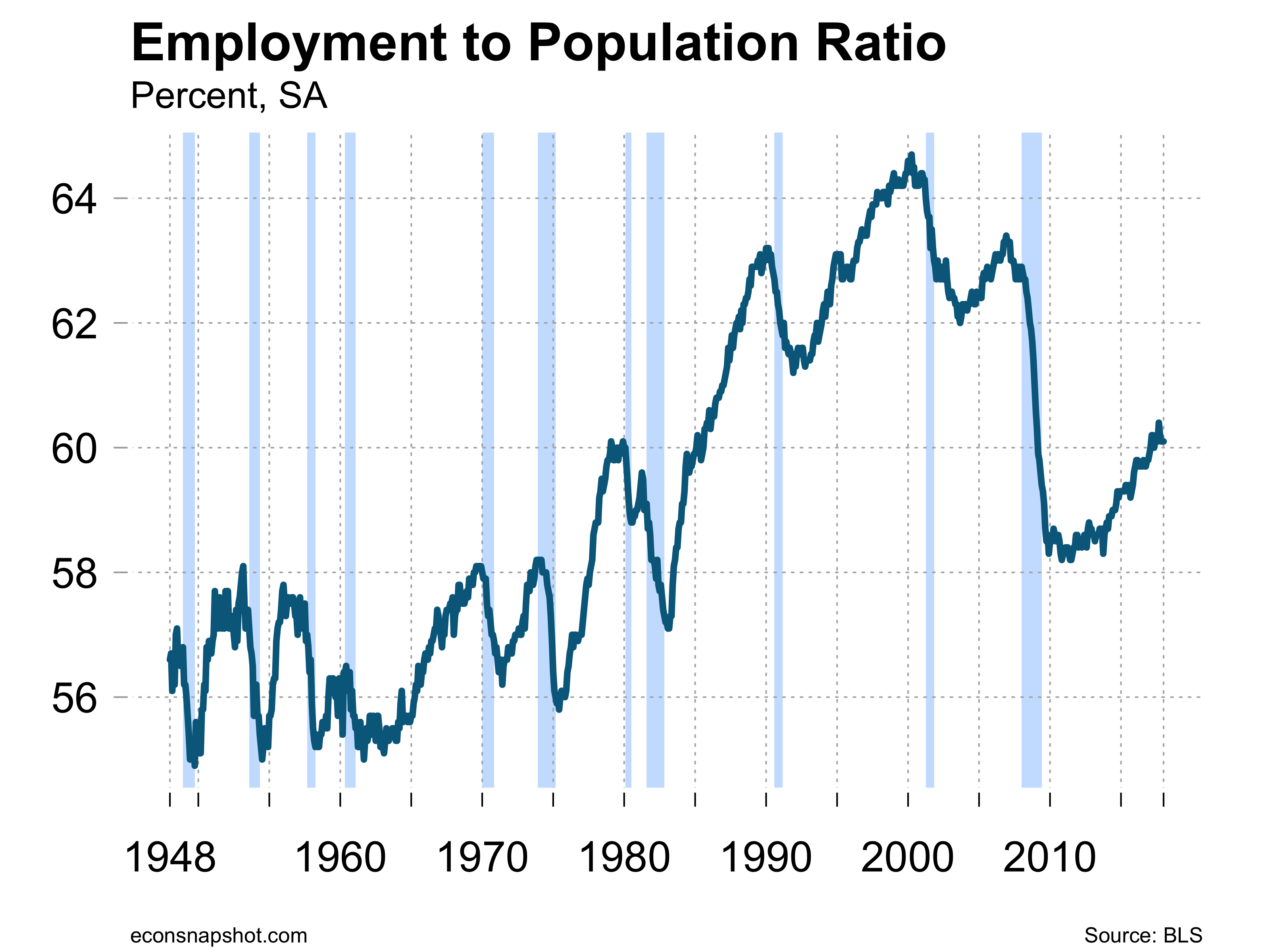
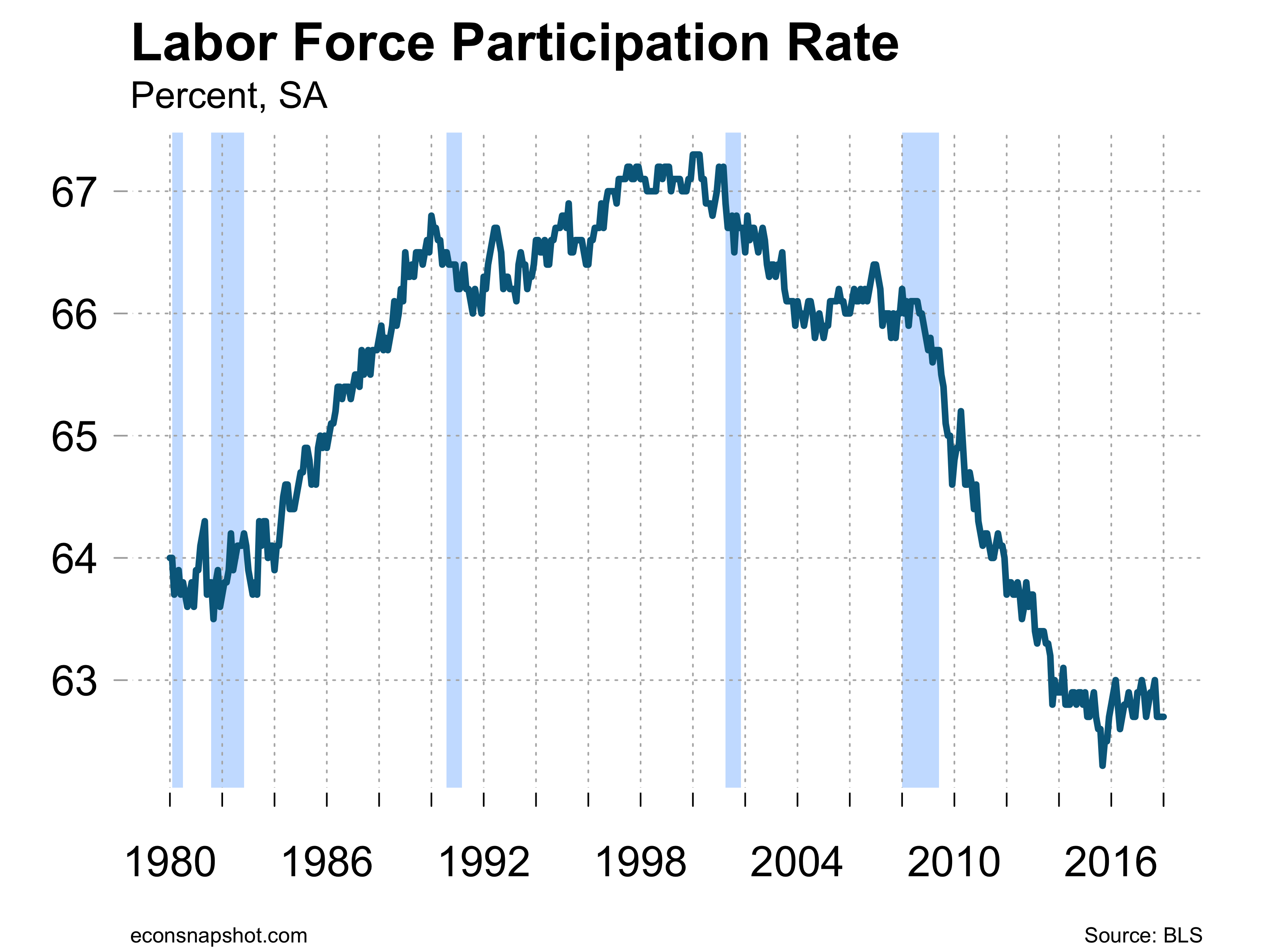
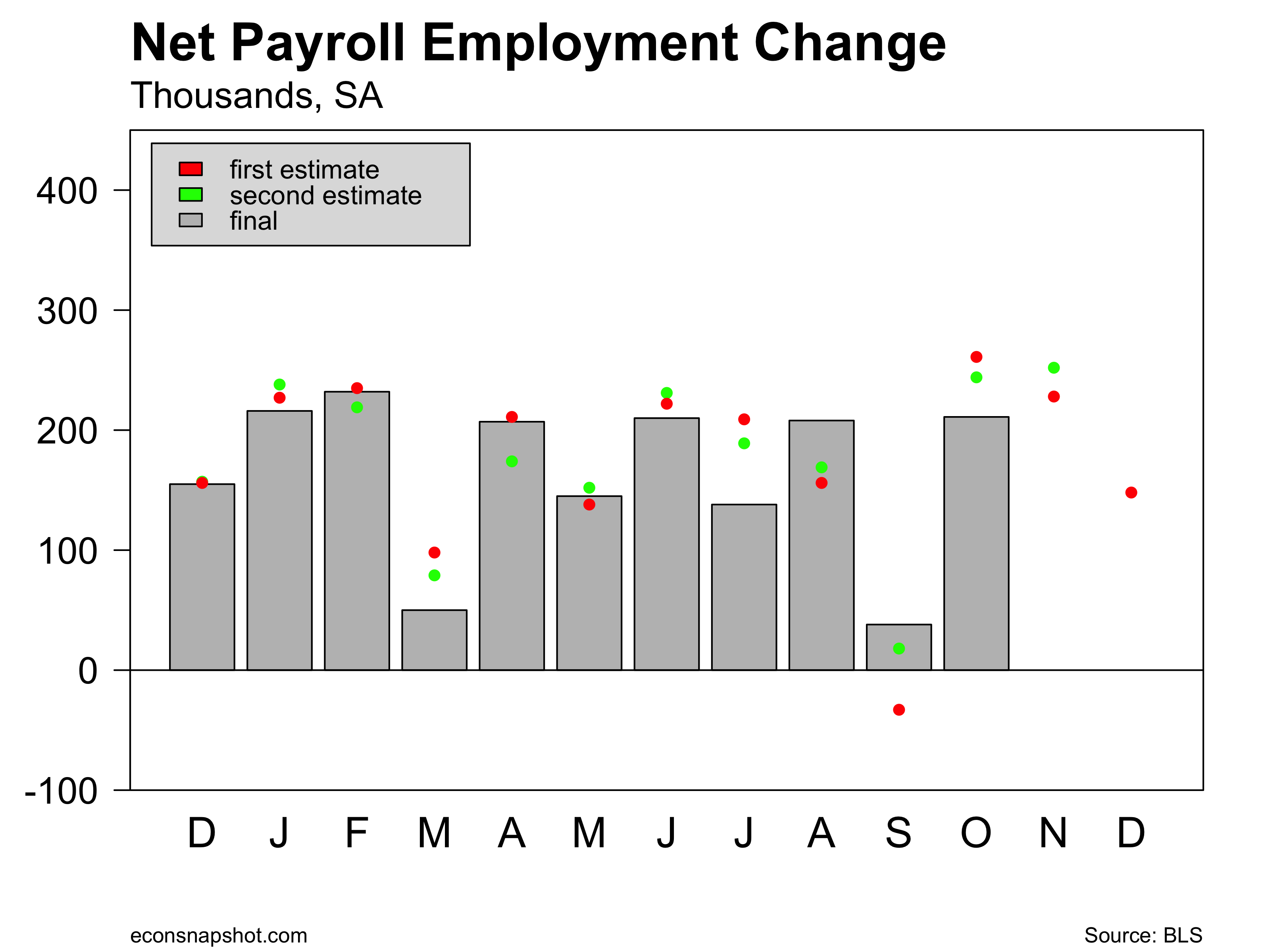
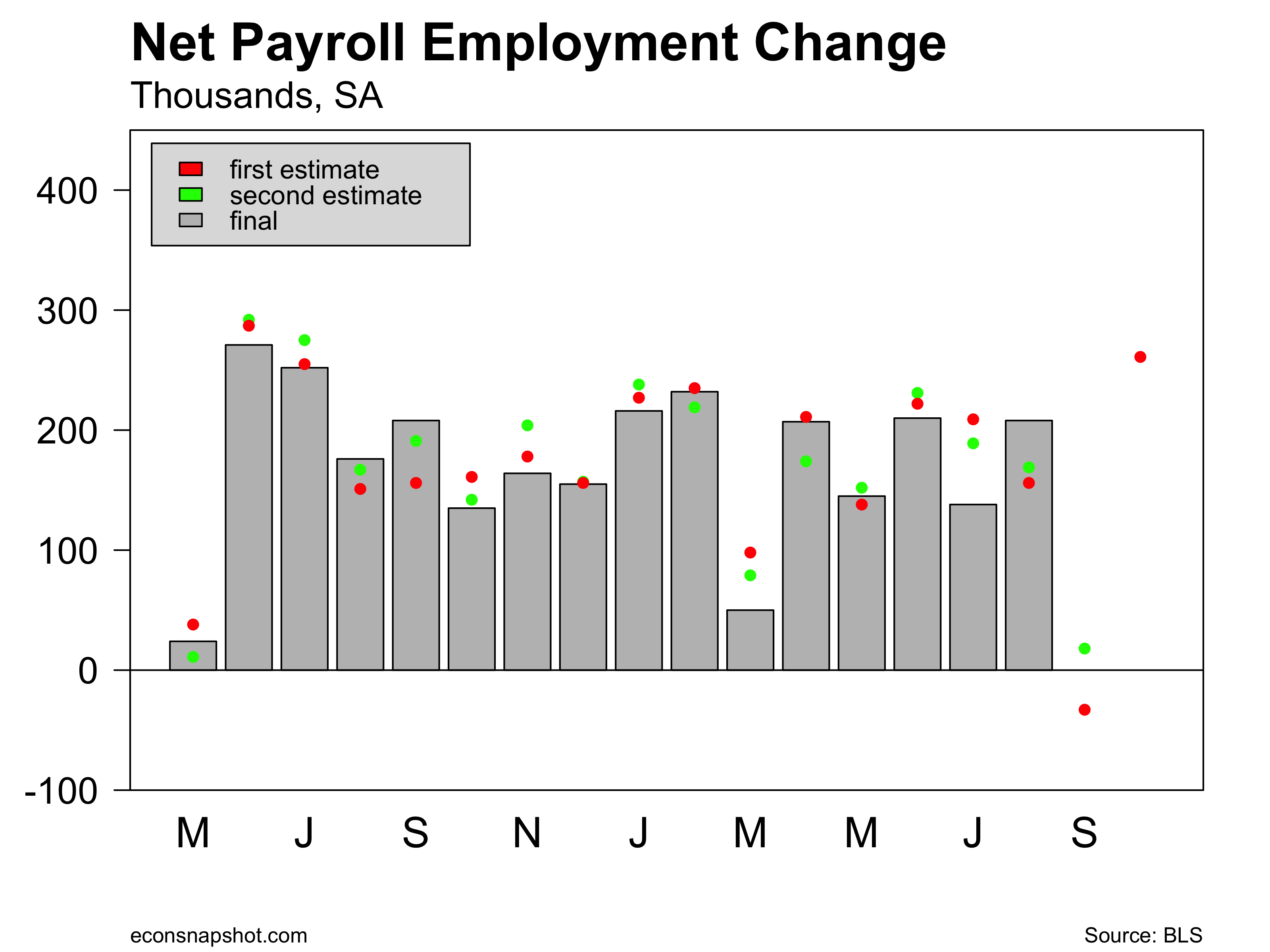
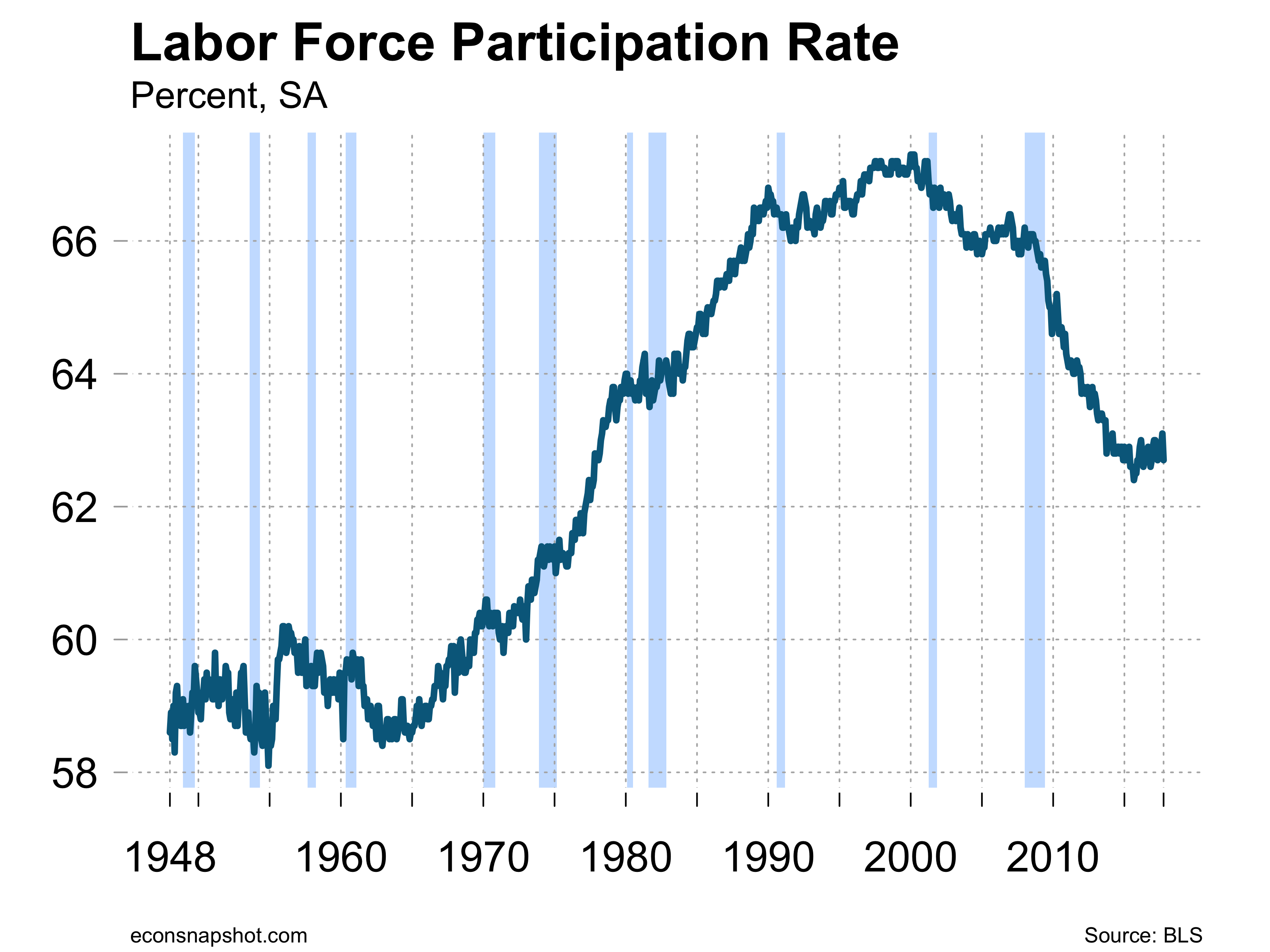
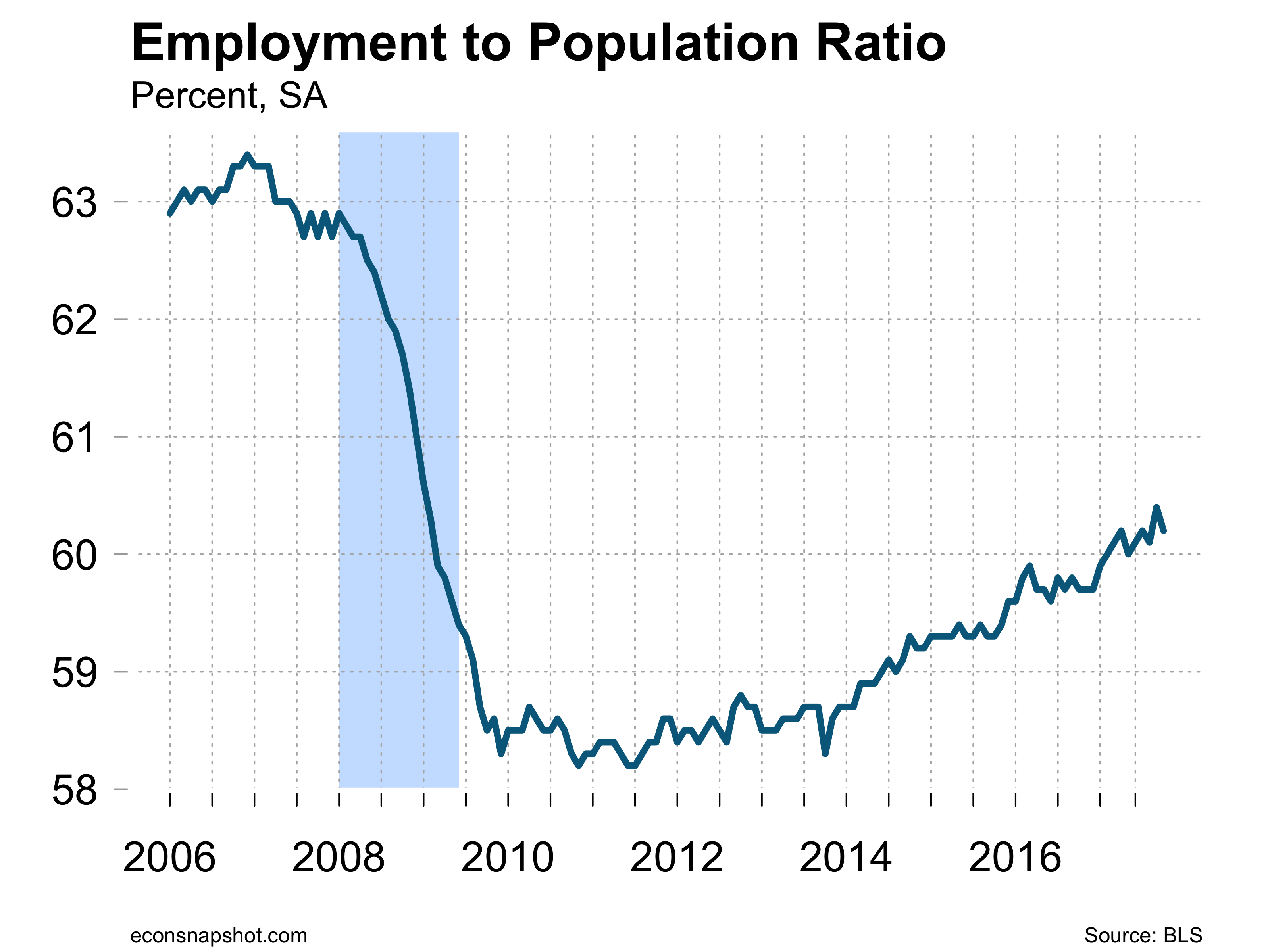
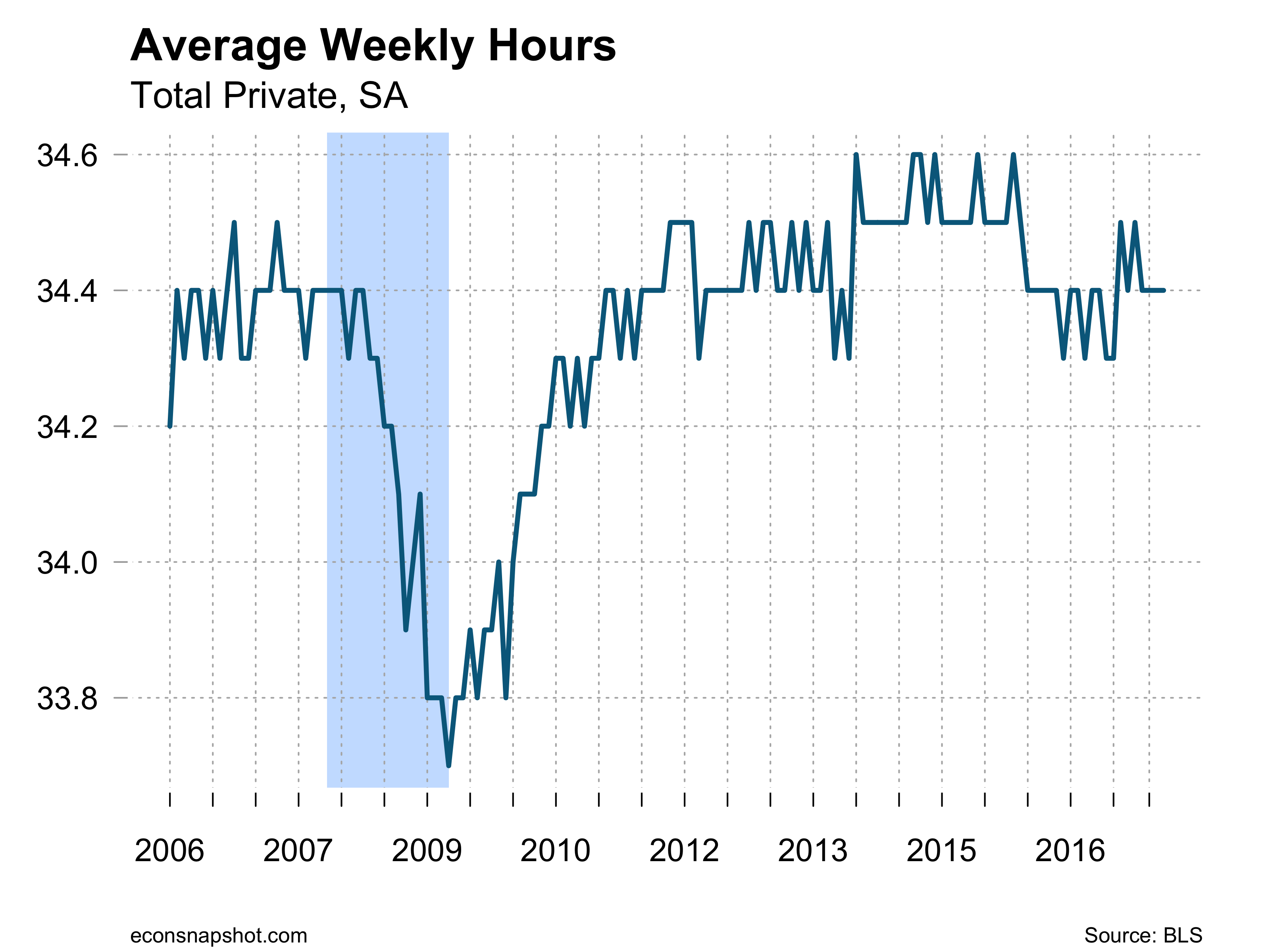
The tiny increase in total non-farm employment reported in the  Employment Situation for March undershot analysts expectations…or rather their hopes? However, there was a little good news. First, January and February employment were revised up, from  +119,000 to +148,000, in January and from +236,000 to +268,000 in February, as can be seen in the employment change graph below.  Second, the average workweek for all employees actually rose to 34.6–only one other time, February of 2012 was it that high since June of 2008. The picture that emerges is of a labor market that usually turns out to be a little bit stronger than first estimates suggest. But, while the economy has continued to add jobs, it has not done so at a pace that is consistent with population growth.  The employment to population ratio ticked down once again from its stubbornly low ratio and the labor force participation continued its steady decline. It is now as low as it has been since the early 1980s. The household survey paints an even more dismal view of the labor market.  Employment declined by more than 200,000, the biggest decline in a couple of years.

Unlike previous months, employment in the government sector didn’t change very much but that is likely to be temporary.  Early indications are that the sequester is gooing to further impact employment in the sector

empchgm-2013-04-05

weeklyhours-2013-04-06

emp-2013-04-05

urate-2013-04-05

epr-2013-04-05

lfp-level-2013-04-05 emp.hh-2013-04-05

lfp-2013-04-05

beveridge-2013-04-05

GDP: Q4 and 2012

The third estimate of Q4 Real GDP, released today indicates anemic output growth of 0.4% (saar), although it was revised up from 0.1%. The estimate for 2012 annual growth stands at 2.2%, higher than the 1.8% growth seen in 2011. Government consumption continues to fall, down 7.0% overall, with federal government consumption down 14.8%.

rgdp-2013-03-28

govcons-2013-03-28

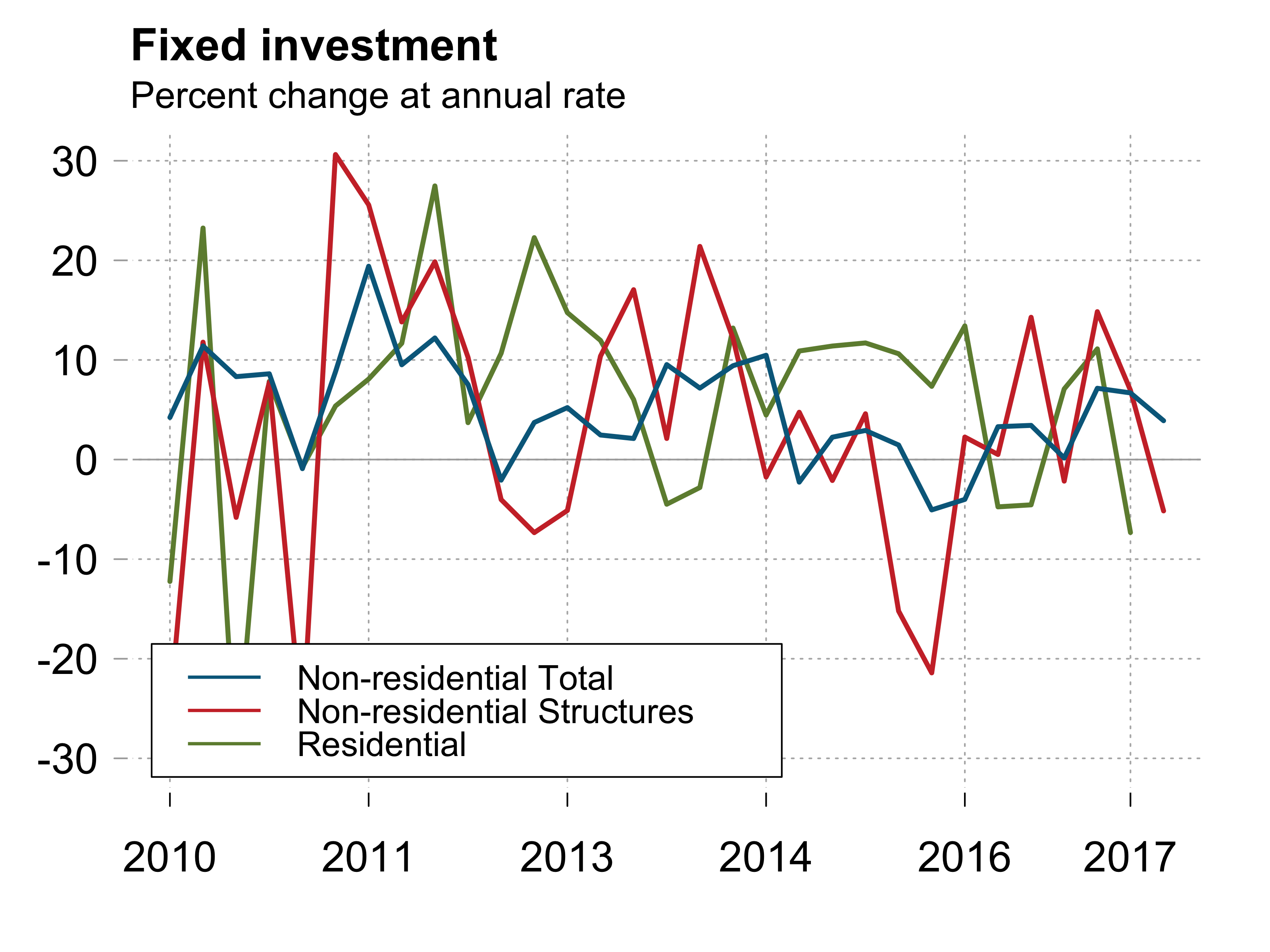
The higher revision came mainly from fixed investment: (advance: 9.7%, second: 11.2%, third: 14.0%) and exports:  (advance: -5.7%, second: -3.9%, third: -2.8%). Consumption expenditures, on the other hand, were revised down (advance: 2.2%, second: 2.1%, third: 1.8%)

cons-2013-03-28

inv-2013-01-30

Continue reading

February Employment Report Beats Expectations

Solid growth in employment

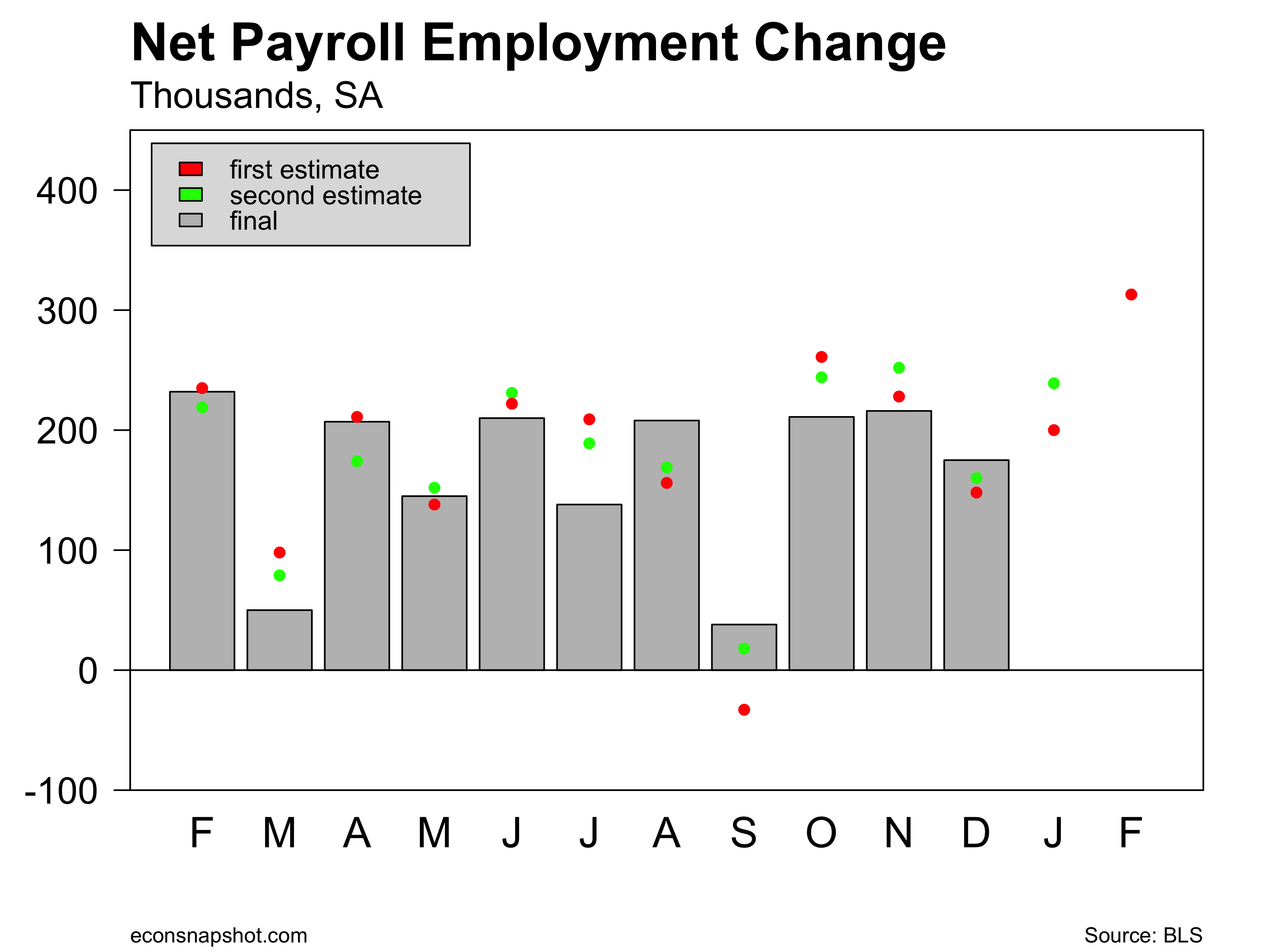
The increase in total nonfarm employment, +236,000 as seen in today’s Employment Situation, beat most analysts expectations, although January employment was revised down slightly, from +157,000 to +119,000, as seen in the Net Employment Change chart below.

empchgm-2013-03-081
Private sector employment was up +246,000 while the government sector continued to shed jobs, -10,000. State government was responsible for 80% of that decline. The largest gain came from private service workers, +179,000. Professional and business services added +73,000. Goods producing employment was also up, +67,000, led mainly by construction, +48,000, and in that sector the largest gain was in specialty contractors. Total employment continues to grow steadily, but is still not back to its level in December of 2007.

emp-2013-03-08

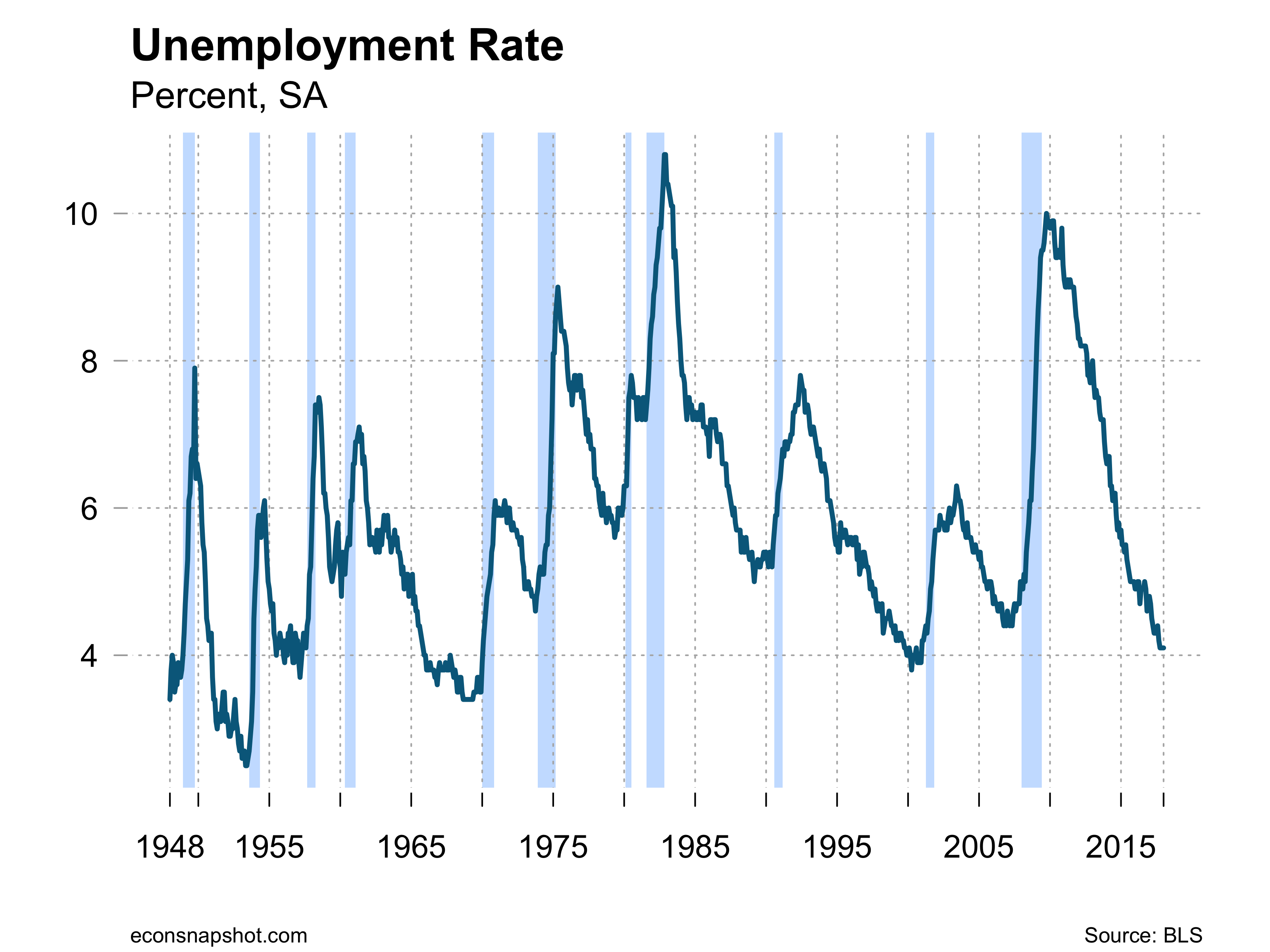
The unemployment rate ticked down from 7.9% to 7.7%, and at 12,032,000 there were about 300,000 fewer unemployed persons compared to last month. However, those unemployed more that 27 weeks edged up by 89,000. Overall there are about 4.7 million persons who have been unemployed more than 27 weeks.

urate-2013-03-08

The employment to population ratio was unchanged from last month at 58.6%, moreover, it was also 58.6% in February of 2012 and was close to that level three years ago. While this picture reveals no growth over the past year, it is not necessarily a sign that labor market is still under considerable duress. There are many factors that drive this statistic, such as decisions about entering the labor force,  retiring, or staying in school. The point is that while the employment population ratio is indicator of labor market health, there are lots of things that drive it. The ratio at the beginning of the recession in December of 2007 may have been “cyclically” high, and now has adjusted to a new level. This can also be seen in the labor force participation rate, which actually declined slightly over the month, from 63.6% to 63.5%.

epr-2013-03-08

lfp-level-2013-03-08 lfp-2013-03-08

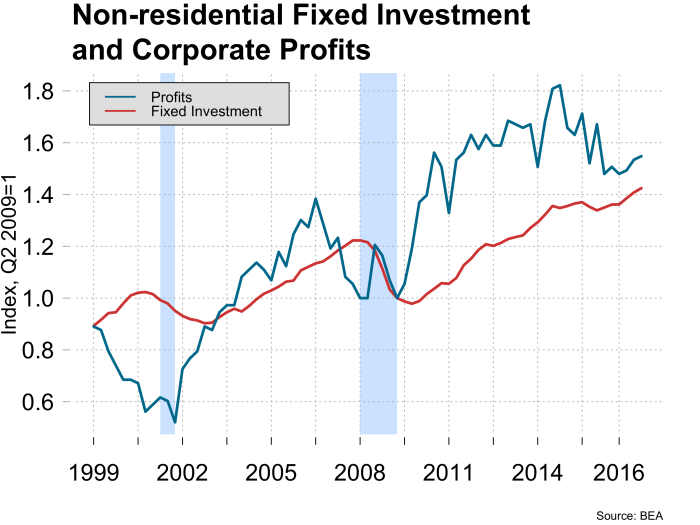
The Beveridge curve depicts the relationship between the reported vacancies and the unemployment rate. As is evident in the graph, the unemployment rate is much higher given the vacancy rate than it was before the last recession. The first red dot to the  left shows that at the beginning of the recession the vacancy rate was about 3% (3 vacancies for every 100 employed) and the unemployment rate was under 5%. Today, the vacancy rate is just under 3% yet the unemployment rate is 7.7%. Why those unfilled vacancies remain unfilled given that level of unemployment remains an open question.
beveridge-2013-03-08

Snapshot: Household and Corporate Finances

Data released by the Federal Reserve shows that household sector debt outstanding rose at a 2.5% annual pace in the last quarter of 2012. It was the first time since the beginning of the recovery that household debt didn’t fall as a percentage of GDP. Households had been steadily de-leveraging until the most recent quarter. Debt to GDP remains 15 percentage points below its level at the peak of the cycle and those levels will not likely be seen again soon. Total borrowing by the household sector also increased in the fourth quarter, indicating that the household sector is willing to take on additional debt in this very low interest rate environment.

hh-debt-gdp2013-03-07

hh-borrow-gdp2013-03-07

In terms of net worth (assets minus liabilities), households’ balance sheets are slowly improving, aided by a recovery in the housing sector and rising equity prices. As a percentage of GDP, the fall in household net worth from the peak in 2007 was 4 times as severe as the fall caused by the dot-com bust that spurred the 2001 cycle. The difference, of course, was the collapse of the housing market. The total market value of real estate assets fell 40 percent more than the fall in GDP. This was combined with a similar fall in the value of household’s holdings of financial assets.

hh-realestate-gdp2013-03-07

hh-financial-gdp2013-03-07

Non-financial business corporate debt rose at an even faster pace in Q4 (8.75% annually). A large portion of the increase was due to increased corporate bond issuance.

bc-debt-gdp2013-03-07

bc-borrow-gdp2013-03-07

There has been a lot of talk (here is one example) about how corporations are hoarding cash and are reluctant to invest earnings. The figure below shows the amount of checkable deposits and currency held by the non-financial corporate sector (only one form of liquid assets corporations hold).

bc-cash-level-2013-03-07

The total size of this cash hoard is now nearly twice as high as it was before the peak of the cycle and nearly $400 billion higher than at the trough. Before you make the call in favor of hoarding though, take a look at the evolution of total currency and deposits as a percentage of total assets.

bc-cash-gdp-level-2013-03-07

As a percentage of total assets, the business corporate sector’s holding of currency and deposits is relatively low and is returning to the levels of the 1980′s. A similar picture can be shown looking at a broader category of liquid assets (including savings, time depots, mmmfs, etc.). There doesn’t seem to be any extraordinary behavior on the side of firms. Similarly, households appear to be carrying relatively low levels of cash and deposits relative to total assets.

hh-cash-level-2013-03-07

hh-cash-assets-level-2013-03-07

Follow

Get every new post delivered to your Inbox.

Join 75 other followers